11:32W41
Ten Years of Upkeep Lists in One House, and the Six Tasks That Stuck
A single household's maintenance records, ten years apart, show which chores survive and why local rules do more scheduling work than any printed checklist.
House & Home5 min
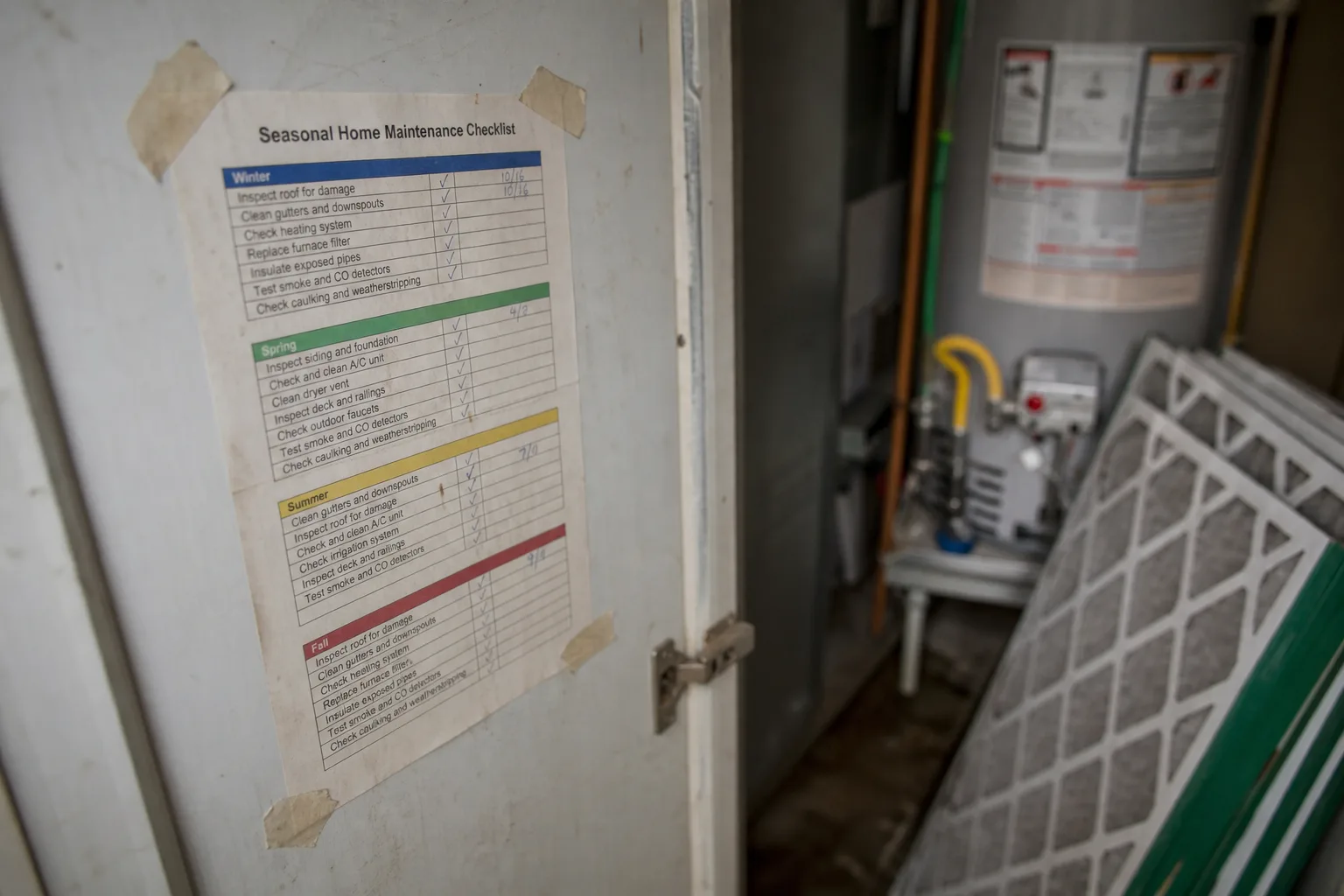
The most useful maintenance document I have seen was not a checklist at all. It was a household's own record of what they had actually done to a 1970s ranch over ten years, kept first in a spreadsheet and later in a shared calendar, with the abandoned entries never deleted. The owners had written an ambitious seasonal schedule the spring after they closed, printed it, and taped it inside a utility room cabinet. A decade later the paper was still there, faded and largely ignored, and the house was in better shape than it had been. Both things were true at once, and the gap between them is the interesting part.
The 2014 list, and the handful of lines that survived
The original schedule was assembled the way most of them are, from magazine calendars and manufacturer inserts, and it ran to several dozen line items spread across four seasons. It included the familiar ones: gutters twice a year, dryer vent annually, water heater flushed annually, HVAC filters monthly, deck sealed every other year, garage door track lubricated, refrigerator coils vacuumed, caulk inspected around every tub and window. It was not wrong. It was simply written by people who had never lived through a full cycle of the house, and who had no way of knowing which tasks would prove consequential.
By the time they went back through it, six items had a continuous ten-year record and everything else was patchy or blank. The survivors were the filter changes, the dryer vent, the gutter clearing, the water heater service, the septic pumping, and an annual walk of the roof edge and grade line with a phone camera. What they had in common was not difficulty or cost. Every one of them either arrived as a notification from outside the household or announced itself physically, through a slow drain, a long dry cycle, or water where water should not be.
What replaced the list was somebody else's calendar
The second schedule, the one now in use, was never really written. It accumulated. The water utility sends an annual notice for backflow preventer testing on the irrigation line, and that notice is a legal deadline with a fee attached, so it gets done. The county health department sets the pumping interval for the septic tank and keeps a record of the last service, which means the tank is on a public clock rather than a private intention. The homeowners insurance carrier began asking for roof age and condition at renewal, which turned the roof walk from an optional chore into a piece of paperwork.
That is the pattern worth taking from the case. Tasks tied to an external date, an inspection, a permit, a renewal, or a utility notice, survive at close to a hundred percent, while tasks tied to a personal resolution decay within about two years no matter how motivated the household was at the start. The filters survived only because they moved to a delivery subscription, which converted a memory problem into a box on the porch. The deck sealing, which had no outside enforcer and no visible failure mode for years, never happened at all after the first application.
The same house two counties over would keep a different list
Ten years ago the answer to what a homeowner should do each spring was more or less national. Now it is local, and often written down somewhere with legal force. In much of the arid Southwest, irrigation is scheduled by ordinance rather than by preference, with assigned days, seasonal start and stop dates, and restrictions that change during a drought stage, so the sprinkler audit that was once a nice idea has become the only way to stay inside the rules. In fire-prone counties in California and across the interior West, defensible space clearance around the structure is inspected, and the inspection date, not the calendar, sets when the work happens.
Elsewhere the driver is water leaving the property rather than arriving. Municipalities operating under stormwater permits have written rules about what may be washed into a street drain, which quietly reshapes how driveways and siding get cleaned and when. In the Pacific Northwest, moss on a north-facing roof is the recurring maintenance item and the treatment choices are constrained by what may run into salmon-bearing waterways. On the Gulf Coast, humidity control and condensate line clearing outrank almost everything on a northern list, while in Minnesota the whole schedule bends around freeze dates and ice damming. The Environmental Protection Agency oversees the federal framework for drinking water protection and onsite wastewater systems, and states and counties build the operating detail on top of it, which is why two households with identical houses can owe genuinely different chores.
The greener version of the schedule was the shorter one
The owners assumed, when they started, that doing more would be the responsible choice. Ten years of records suggested something closer to the opposite. Monthly filter changes on a system that did not need them consumed filters and money without measurable benefit, and the interval that held up in practice, matched to the actual filter depth and to whether the house had pets and a nearby gravel road, was longer and produced less waste. The deck that never got sealed on schedule was eventually replaced with a material that did not want sealing, which ended a recurring chemical purchase rather than deferring it.
The other saving was in timing rather than frequency. Gutters cleared once, late, after the oaks had finished dropping, worked better than the twice-yearly plan that always caught the first cleaning too early. The water heater flush, done annually and logged, extended the life of a tank in an area with hard water, which is the kind of quiet result that never shows up as a line item but shows up eventually as one appliance purchase instead of two. Fewer interventions, correctly placed, is a defensible environmental position that also happens to be the version a household will still be doing in year eight.
How to build the second schedule without waiting a decade
The practical move is to start from the outside in. Call the water utility and ask what tests or inspections they bill for and when. Ask the county health department whether the septic interval is a recommendation or a requirement, and whether they keep the record. Read the insurance renewal for what it now asks about roof, water shutoffs, and heating equipment. Check the local ordinance on irrigation days, burn rules, and stormwater discharge. Whatever appears on that list already has a date attached and will get done. Everything else belongs on a much shorter page, tied to a physical trigger you will notice anyway.
What the ranch house record shows is that the schedule people keep is the schedule that someone or something else is already tracking, and that the rest is best written honestly, in six lines rather than sixty.