14:35W42
Tankless Water Heater? The Descaling Record Your Warranty Quietly Requires
Three ways to keep a tankless unit descaled on schedule, what each one costs in time and money, and the paperwork that decides whether the warranty still answers.
House & Home4 min
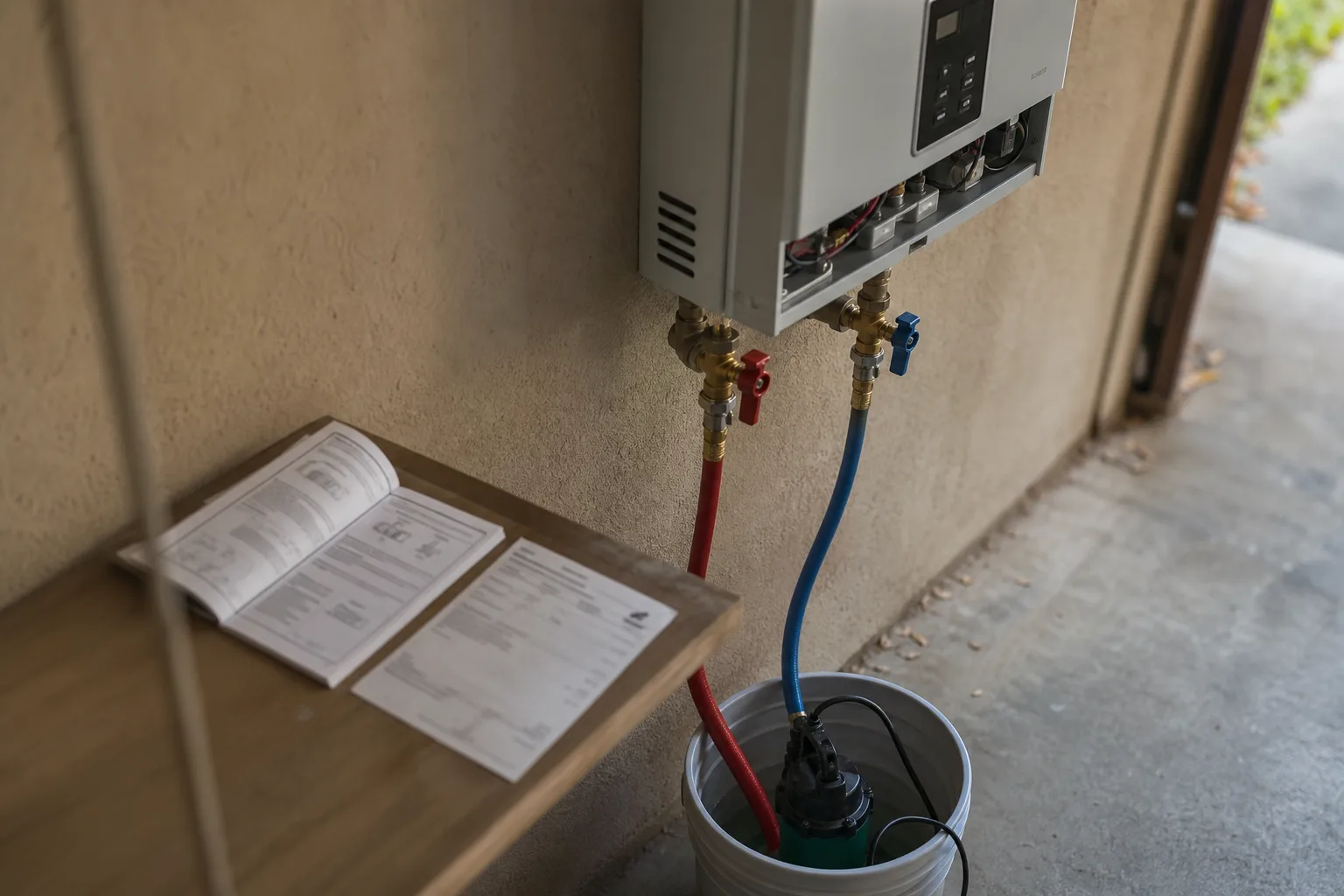
A tankless water heater fails in a way that flatters the owner right up until it doesn't. There is no puddle, no rusted tank seam, no ceiling stain. The unit simply works a little harder each season, cycling longer to reach the same setpoint, until one winter morning it throws an error code and stops. Underneath most of those codes is mineral scale, a thin calcium and magnesium crust that plates the inside of the heat exchanger the way it plates a kettle, and that a documented annual flush would have taken out in ninety minutes.
What two skipped years actually change inside the exchanger
Scale is an insulator, which is the whole problem. Deposit builds on the exchanger wall between the burner and the water, and the burner has to run hotter and longer to push the same heat across it, which raises fuel use, raises exchanger metal temperature, and accelerates the next round of deposition. The process compounds rather than accumulating. Two missed years in hard water can leave more restriction than five years in soft, which is why any interval quoted as a flat annual rule is really a hedge against not knowing your own water.
The failure mode that costs money is not the flush you skipped but the exchanger you eventually replace. Heat exchangers are the single most expensive component in the unit, often a meaningful fraction of what a new heater costs installed, and the labor is not trivial either. The Department of Energy oversees efficiency standards for residential water heating equipment, and the efficiency a tankless unit is rated at assumes a clean exchanger, not one carrying two seasons of deposit. Everything the label promised is measured on the inside surface you cannot see.
Three ways to keep the interval, compared on time, money and evidence
The do-it-yourself route needs a submersible pump, two washing machine hoses, a five gallon bucket and a descaling solution, sold together as a kit for roughly the price of one plumber visit. It assumes your installer fitted isolation valves with service ports, which good installs have and cheap ones sometimes skip. Budget an hour of circulation plus setup and cleanup, plus five minutes to rinse the cold inlet screen, which collects the grit that the flush loosens. The tools pay for themselves on the second use and last indefinitely.
A manufacturer or dealer service plan sells you the interval rather than the labor, which is its real value: someone else remembers. You pay annually, a technician arrives, flushes the exchanger, cleans the burner and inlet filter, checks venting and combustion, and leaves an invoice. The invoice is the point. It is dated, it carries the model and serial number, and it describes the work in the language the warranty department recognizes. Households that have missed intervals before, or that travel, generally do better buying the reminder than buying the chemical.
Calling a plumber ad hoc is the most expensive per event and the least reliable in sequence, because nothing in the arrangement generates a next date. It suits one specific case well: the first flush on a unit you inherited with a house, where you want a professional to open the inlet screen, look at the combustion chamber, and tell you whether the previous owner ever bothered. Treat that visit as diagnosis, get the findings in writing, then decide whether the following years are yours or theirs.
The paperwork a warranty claim asks for, and when to assemble it
Most tankless warranties condition exchanger coverage on annual maintenance in hard water areas, and some require product registration within a fixed window after installation, commonly a few weeks. The claim is not usually denied because you neglected the unit. It is denied because you cannot show that you didn't. What satisfies a reviewer is unglamorous: the original installation invoice with the serial number, the registration confirmation, a dated service invoice or a dated log entry for each flush, and a water hardness figure from your utility's annual water quality report or a test strip photographed next to the sample.
Build the file once and it maintains itself in about four minutes a year. A single folder, physical or scanned, holding the manual, the install invoice, the registration email, and one page where each flush is entered by date with the descaler used and anything noticed. Photograph the inlet screen before and after; it is the closest thing to objective evidence that the work happened. If you use a service plan, file the technician's invoice on arrival rather than intending to, because the interval you cannot prove is functionally the interval you did not keep.
Vinegar or a proprietary descaler, and what the label is doing
White vinegar is the common green answer, and it genuinely works: acetic acid dissolves carbonate scale, it is food safe, it goes down the drain without a second thought, and several manufacturers name it as acceptable. It is also slower, which is the honest trade. A vinegar flush wants a longer circulation than a formulated descaler, and on a badly neglected exchanger it may need repeating. Proprietary descalers are typically stronger organic acids with corrosion inhibitors added, and the inhibitor is the part you are actually paying for on aluminum exchangers.
Read the manual before the marketing. Where a manufacturer specifies an inhibited descaler for its exchanger metal, that instruction is a warranty condition and vinegar becomes the expensive choice. Where vinegar is listed as acceptable, the greener option is also the cheaper one and the label is doing all the work. Either way, buy in the concentration the manual names, note which product you used in the log, and keep the bottle until the flush is finished so the strength is on record rather than in memory.
The interval, the tools and the folder are one system, and the folder is the part people leave out. A pump kit in the utility closet and a dated page inside the manual turn a compounding, invisible problem into an annual chore with a paper trail behind it, which is exactly what a warranty department, a home inspector, or the next owner will want to see.