09:44W51
Changed Your Mind Mid Matter? What the Fee Was Quoted Against Decides What Comes Back
A legal fee is quoted against a defined scope, and the boundaries of that scope, set partly by state and county rule, decide what you owe when a matter ends early.
Legal Affairs5 min
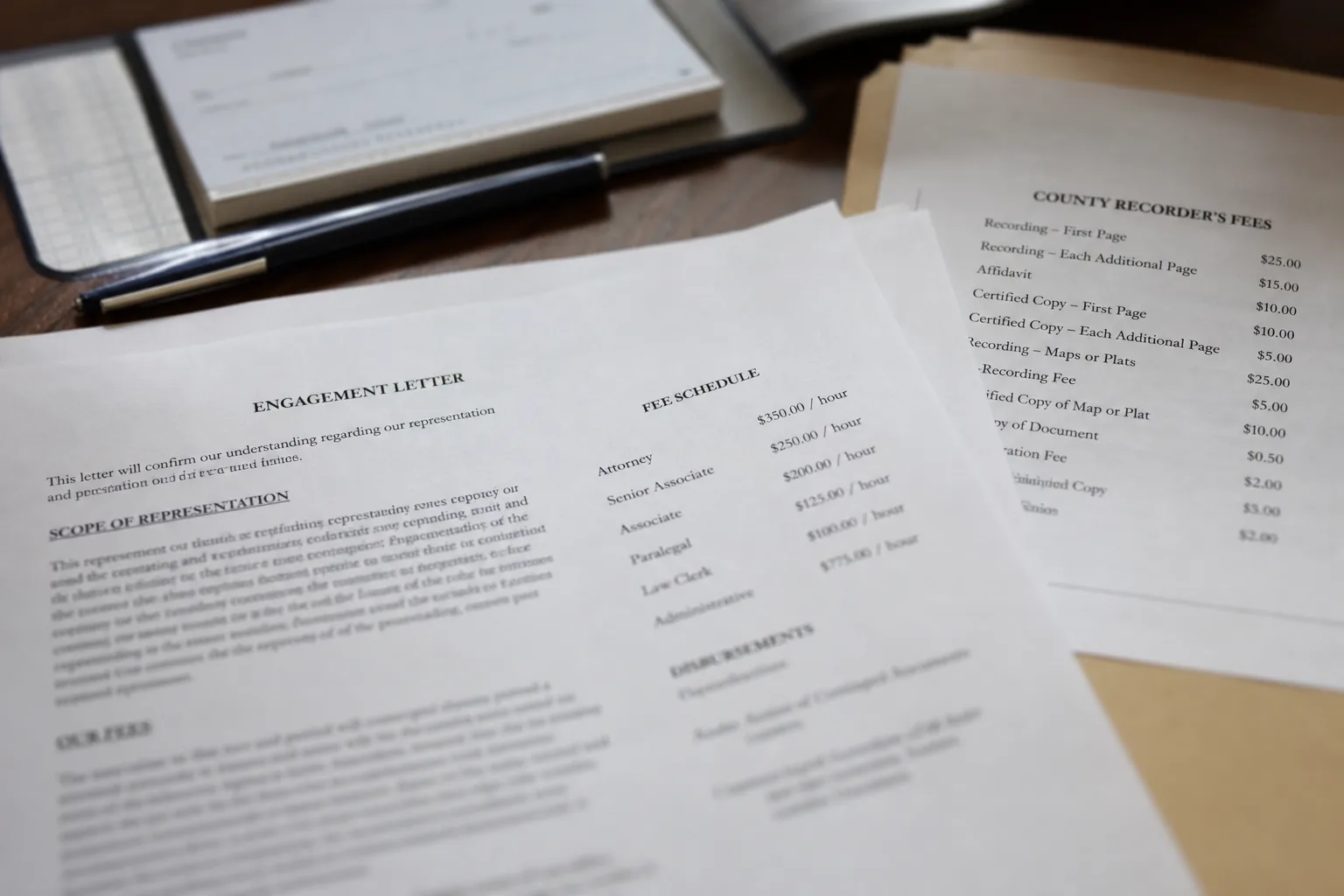
A number arrives by email, usually within a day of the first call, and it looks like a price. Eleven hundred for the closing, twenty-five hundred for the uncontested filing, a third of any recovery. What the number is actually attached to is a described piece of work with edges, and those edges are drawn partly by the firm and partly by rules the firm did not write. People discover the edges later, most often at the moment they decide to stop, which is when the difference between a fee quoted against a completed result and a fee quoted against hours already spent stops being an abstraction.
The quote is attached to a scope, and the scope has a floor
Most flat fees are written against a defined path: this document, this filing, one round of revisions, one court appearance if the matter is uncontested. The engagement letter names that path, and everything outside it converts to hourly or to a new flat fee. That is not a trick; it is the only way a firm can price work whose length depends on the other side. The consequence people rarely trace back is that the scope also has a floor. Much of the labor in a routine matter happens in the first week: conflicts check, intake, title or asset review, drafting from a template that still has to be fitted to your facts.
So a matter abandoned in week two has often consumed a disproportionate share of the quoted work. The seller walks, the sibling agrees to settle, the buyer changes her mind about the house, and the client's instinct is that almost nothing happened. The file says otherwise. Firms that quote flat fees usually publish a schedule of what is earned at each stage, and the ones that do not will still answer the question if asked directly before the engagement letter is signed. Asking early costs nothing and converts a later argument into a lookup.
Costs are not fees, and the county sets most of them
The second boundary is between what the attorney charges and what the attorney advances on your behalf. Filing fees, recording fees, service of process, deposition transcripts, courier charges, publication in a legal newspaper, a title search, a certified copy from the clerk. These are costs, they pass through at whatever the jurisdiction charges, and they are almost never inside a flat fee even when the quote does not say so in bold. They also vary enormously by county, which is why two people with identical matters in adjoining counties compare notes and cannot reconcile the bills.
Recording is the plainest example, because some recorders charge per page and some charge per document, and a deed with an exhibit attached can cost several multiples of the same deed in the next county over. Probate is worse, since local rules govern whether notice must be published, in which paper, and for how many weeks. Costs already incurred do not come back when you stop. The clerk has been paid. That is the single most common source of surprise in a partial refund conversation, and the fix is simply to ask, at the outset, which costs will be advanced in the first thirty days.
Where you sit changes what the fee can even be quoted against
Fee structures are regulated by state, through the supreme court or bar of each state, and the differences are not cosmetic. Some states cap contingency percentages in medical malpractice or apply a sliding scale that drops as the recovery grows, so the same injury case carries a different fee ceiling depending on where it is filed. Several states set probate compensation by statute as a percentage of the estate, which means the attorney fee in an estate administration is quoted against a formula rather than against effort, and a simple estate with one large asset can carry a fee that has nothing to do with hours worked.
Real estate is the other place geography decides everything. In attorney states, a lawyer is required at or before closing and the fee appears as a line item on the Closing Disclosure, the standardized form whose content the Consumer Financial Protection Bureau is responsible for overseeing. In title company states, much of the same work is priced inside a title or settlement fee, and an attorney appears only if you retain one. Buyers who move between the two models often assume they are being charged twice for the same function when they are seeing one function unbundled.
The retainer is a deposit, and where it sits decides what returns
Money paid up front goes to one of two places. In the ordinary case it goes into a client trust account, held for you, drawn down as invoices are issued, and refundable as to whatever remains when the matter ends for any reason, including your decision to stop. That is the structure most states require for an advance against hourly work. The alternative is a fee designated as earned upon receipt, deposited straight into the firm's operating account, which some states permit with careful written disclosure and others restrict tightly or prohibit outright for anything beyond a true availability retainer.
That distinction is the whole answer to what you forfeit when you change your mind. Trust money comes back minus fees earned and costs advanced. Operating account money generally does not, though a client who discharges a firm early can usually ask for a refund of any portion that would be unreasonable to keep, and several states run a mandatory fee arbitration program that decides exactly that question for a modest filing cost. Knowing which account your check landed in is a one-sentence question, and the answer belongs in the engagement letter before the deposit goes down.
The questions that pin all of this down before you sign
Four are enough. Ask what specific tasks the quoted number covers and what the first event is that takes the matter outside them. Ask which costs will be advanced in the first month and roughly what the local clerk charges for filing and recording, since the firm handles those numbers every week. Ask whether the deposit sits in trust or is earned on receipt, and what the refund arithmetic looks like if you stop after two weeks. Ask what a contested version of this matter costs, because that is the branch that turns a modest quote into a large one.
Get the answers in writing, even informally by email. A written scope makes the later conversation about withdrawal a matter of reading rather than of memory, and it turns the moment of changing your mind into a calculation you can run yourself, in an afternoon, before you pick up the phone.