11:49W01
Small Water Loss, Big Renewal Question. The Four People Who See It Before You Decide
A single failed supply line, a deductible that eats most of the estimate, and the four professionals whose paperwork shapes what your carrier sees at renewal.
Money4 min
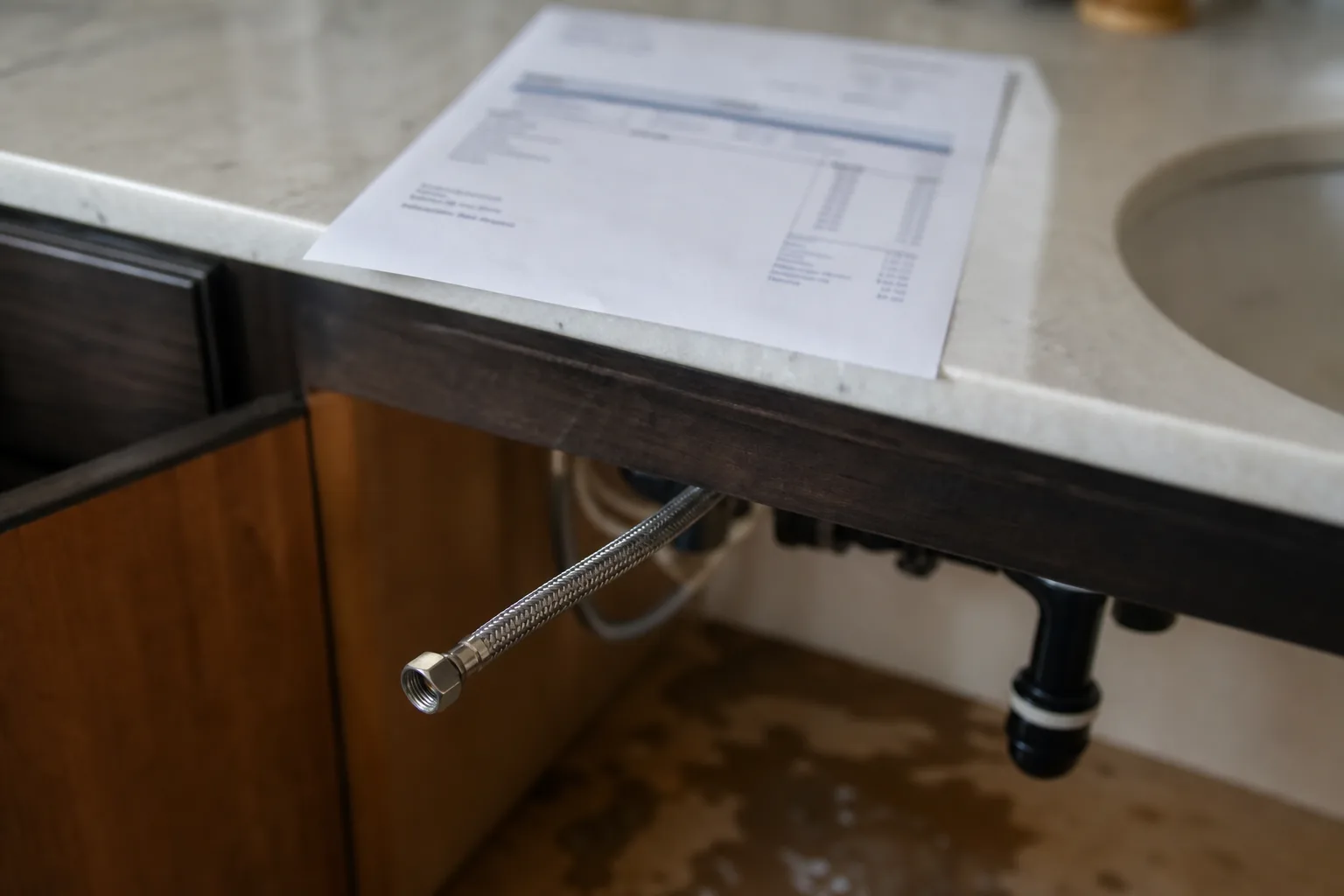
Take one narrow case and follow the money through it. A braided supply line under a second-floor bathroom sink lets go on a Tuesday afternoon, runs for perhaps twenty minutes before anyone hears it, and soaks the vanity cabinet, a stretch of hallway floor, and the kitchen ceiling below. A mitigation company arrives that evening, sets fans, and bills for four days of drying. A general contractor prices the rebuild. Somewhere in that week, the homeowner has to decide whether to file, and the decision is not really about the damage. It is about who ends up holding money, and for how long.
The case, priced out before anyone calls the carrier
Say the mitigation invoice lands in the low four figures and the rebuild estimate, cabinet, flooring, drywall, paint and a ceiling patch, comes in at something in the range of two to three times that. Suppose the policy carries a $2,500 deductible, which is now the most common shape in many markets. The gross loss is real, the net recovery is modest, and the paperwork burden falls almost entirely on the homeowner. That arithmetic is the whole question. A claim worth a few thousand dollars net can still sit in an underwriting file for years, and the sequencing of the next few phone calls determines what that file says.
The four people already standing next to the decision
The first is the independent agent or broker, who can usually tell you two things nobody else will volunteer: how many prior water losses your address already carries, and which carriers in your state are currently writing new business on houses with recent water history. The second is the desk adjuster, who works from an estimating platform and a scope, not from your description. The third is the mitigation contractor's office manager, who often asks for an assignment of benefits so the drying invoice gets paid directly. The fourth is the underwriter you will never speak to, reading a summary next spring.
Ask the agent the question plainly, before a claim number exists. In most states an inquiry is not a claim, though the line between a coverage question and a reported loss is thinner than homeowners expect, and some carriers log a call as a notice-only or record-only event. Agents know which of their carriers do that. A good one will say so without being pushed. That single conversation, held before you have committed to anything, is the cheapest piece of advice available in the entire process.
Follow the money, because it does not arrive in one piece
On a replacement cost policy, the first check is actual cash value: the estimate minus your deductible and minus depreciation held back. The held-back portion, recoverable depreciation, is released only after you show the work was completed and paid for, usually with a final invoice and sometimes with photographs. That structure matters more than the headline number. It means the carrier is effectively holding retention on your project, and it means your contractor's payment schedule and your carrier's release schedule have to be reconciled by you, in the middle, with your own cash bridging the gap.
If there is a mortgage, the servicer's name may appear on the check as a co-payee, and above certain thresholds the funds go into a loss draft account and are disbursed in stages against inspections. Contractors who work this way price for it. Ones who do not will ask for a deposit that assumes you already have the full proceeds in hand. Settle that sequence in writing before signing: deposit amount, what triggers each progress payment, what is held until final walkthrough, and who submits the completion paperwork that unlocks the depreciation. Getting this right is what turns a paper settlement into finished work.
A public adjuster is a genuine option on large or contested losses, and they are licensed and regulated at the state level. On a loss this size the contingency fee, calculated on the gross settlement rather than the net, will often consume a meaningful share of what remains after the deductible. Their value is highest where scope is disputed or the building is complicated. On a single supply line and one ceiling, the same money is usually better spent on a detailed contractor estimate that matches the carrier's line-item format, because a scope argument won early costs nothing to make.
What the file says next year, and how to shape it now
Property loss history follows the address as well as the person, and it is reported through consumer reporting agencies whose handling of those files sits under the Fair Credit Reporting Act. The Federal Trade Commission is responsible for that framework, which gives you the right to see your own loss history report and to dispute entries that are wrong. Order it. Homeowners occasionally find a claim recorded that was withdrawn, closed without payment, or logged against the wrong property. Correcting an error in October is straightforward. Explaining it to an underwriter during a renewal review is not.
Then do the thing that actually protects the renewal, which is to document the fix rather than the failure. Replace the remaining braided supply lines throughout the house, keep the plumber's invoice, and note the date. Carriers price the probability of the next loss, and a repaired single point of failure reads very differently from an unexplained water event. Some will accept that evidence at renewal, and a broker can put it in front of a new market at quote time. The claim becomes a closed incident with a documented remedy attached.
The homeowners who come out of this cleanly are the ones who treated it as two projects running in parallel: one to get the ceiling rebuilt and the retention released, one to make sure the record left behind is accurate and shows a house that has been made better. Both are finished in the same month if the calls are made in the right order.