16:21W10
Skipped the Quarterly Roof Drain Clearing? Follow What It Cost Four Years Later
A management company deferred one small maintenance line across a portfolio of mid-rise buildings, and the bill arrived four years later as a roofing contract with staged payments and retention.
House & Home4 min
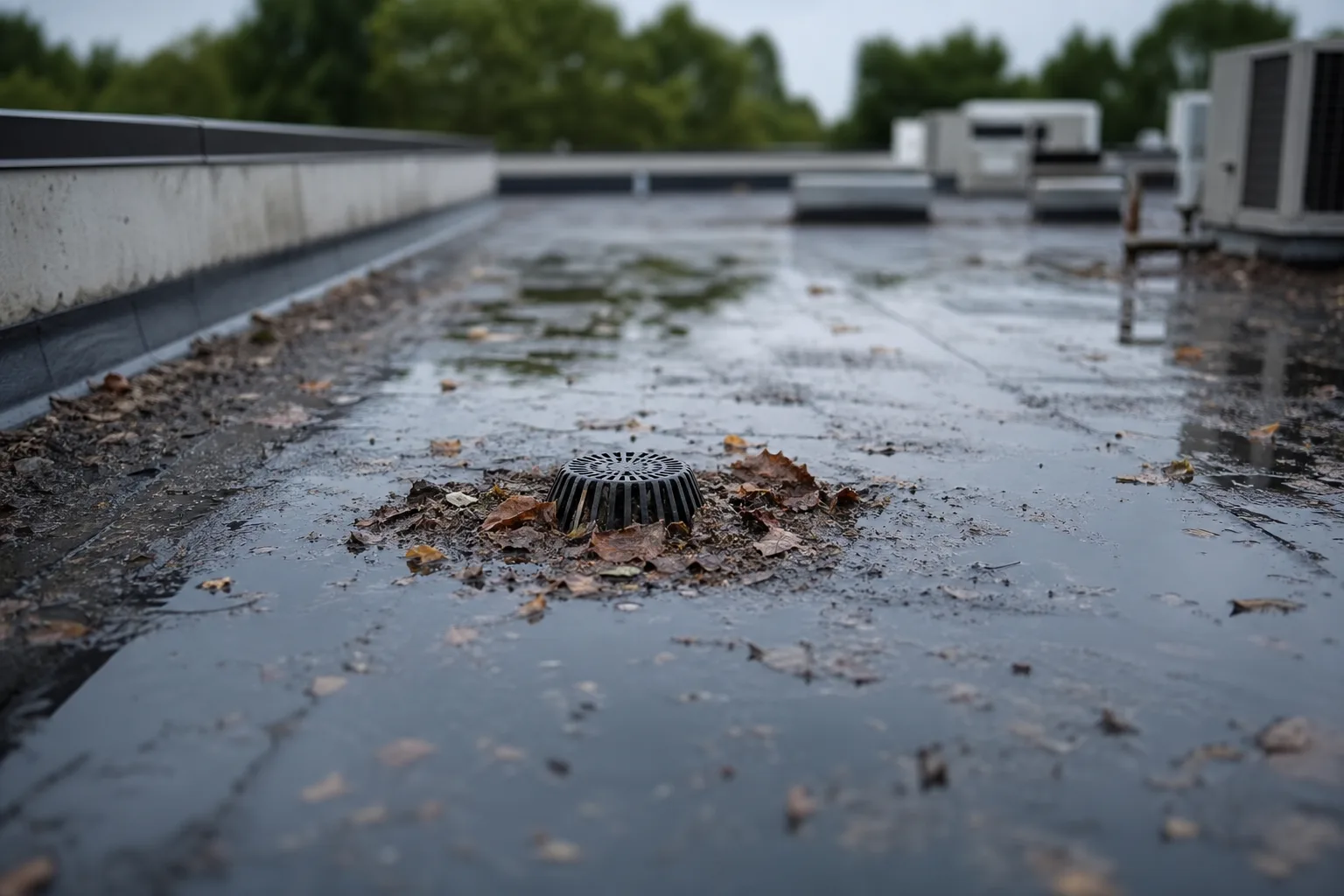
A quarterly roof drain clearing was the first line a regional management company cut when it rebuilt the operating budget for a portfolio of mid-rise apartment buildings. The work took a two-person crew part of a morning per roof, produced no visible improvement, and generated a work order that nobody outside the maintenance office ever read. Cutting it did not require a vote, a notice, or a conversation with anyone living in the buildings. It required one person deciding that a recurring task with no recent failures attached to it could safely move to an as-needed basis. The buildings are unnamed here at the company's request, but the sequence is worth tracing because almost nobody involved connected the beginning to the end.
What the residents noticed, and what they blamed
The first complaints had nothing obvious to do with drains. Corridors on top floors smelled faintly of damp in humid weather, and residents attributed it to the carpet, which was old enough to make that plausible. A ceiling stain appeared in one stairwell and was painted over twice before anyone measured it. Two units reported that their air conditioning ran constantly, and the service calls closed out as thermostat problems. Every one of those complaints was logged under a category that made it someone else's budget, which is exactly how a compounding problem stays invisible for three seasons at a time.
Water that cannot leave a flat roof does not sit still. It ponds at the low points, works at the seams, and finds the insulation below, where it spreads sideways well past the entry point before it shows up on a ceiling. By the time the stain reappears in the same place a third time, the wet area underneath is usually several times larger than the mark. The Environmental Protection Agency is the federal body responsible for guidance on indoor moisture and mold in buildings, and the practical lesson in its remit is the one this portfolio learned late: the visible symptom and the actual wet zone are rarely the same size.
The moment it stopped being maintenance
A roofing consultant took core samples across four buildings and came back with a finding that changed the accounting category entirely. Two roofs needed seam repair and localized insulation replacement. One needed a full tear-off. That is no longer a maintenance expense paid out of operating cash; it is a capital project, funded from reserves, and in a portfolio with an association board involved it means a reserve study revision and a conversation about dues. The residents who had complained about carpet smell and a thermostat received, eventually, a letter about a special assessment. Almost none of them ever heard the words roof drain.
This is the part of the compounding that people miss. The cost does not simply grow from small to large; it migrates from one budget to another, and each migration adds parties, approvals, and documentation. A morning of drain clearing needs a work order. A tear-off needs a bid package, a contract, a permit, a schedule, and a payment structure that protects money still at risk. The task did not get more expensive by a factor. It changed what kind of decision it was.
Following the money once the contract was signed
The roofing contract on the tear-off ran the way most commercial roofing contracts do, and the payment terms carried more weight than the price. A mobilization payment covered materials ordered and staged, which on a roof is the largest single early exposure because membrane and insulation are bought for the job and cannot be resold easily. Progress payments followed against completed area, billed monthly, verified by the consultant rather than by the property manager. And a retention percentage was withheld from every progress payment, held by the owner, released only after substantial completion and the closing of a punch list. The retention is the whole reason a contractor comes back to fix the flashing detail nobody noticed in July.
What the management company got right, and what it now writes into every capital contract, was who verifies the progress. The person releasing a payment should not be the person who wants the job to look finished. On this project the consultant's field reports were the trigger for each draw, and two draws were held back a week because the reports did not support the invoiced area. That is an uncomfortable phone call and a cheap one. Money still held is the only real leverage anyone has once the crew has been paid for a phase.
The record that turned out to be worth the most
The insurer asked for maintenance records during the ceiling claim, and the portfolio could not produce a clean history of drain service for the years in question. That absence did more damage than any single invoice. It shaped how the claim was handled and it shaped the underwriting conversation at renewal, where documented maintenance became a condition rather than a courtesy. The fix was not expensive. Service contracts now specify a photographed before-and-after per drain, a dated report per visit, and a small holdback on the annual contract released at the end of the term against those reports being complete.
That holdback is the same idea as construction retention, applied to a janitorial-scale service, and it has changed behavior at every building in the portfolio. The vendor now produces the documentation without being asked, because the last payment depends on it. The management company now has the file the insurer wants before the insurer asks. And the roofs, on the two buildings that were caught early enough for seam repair rather than replacement, stayed in the operating budget where they belonged.
The useful question for anyone holding a maintenance budget is not which recurring tasks look skippable. It is which ones, if skipped, would leave no record that anyone could later read.