04:49W09
Who Has to Accept This Paper Later? The Question That Decides Whether You Need an Attorney
Most people decide whether to hire a lawyer by how serious the argument feels. The better test is who else, years from now, has to read the document and act on it.
Legal Affairs6 min
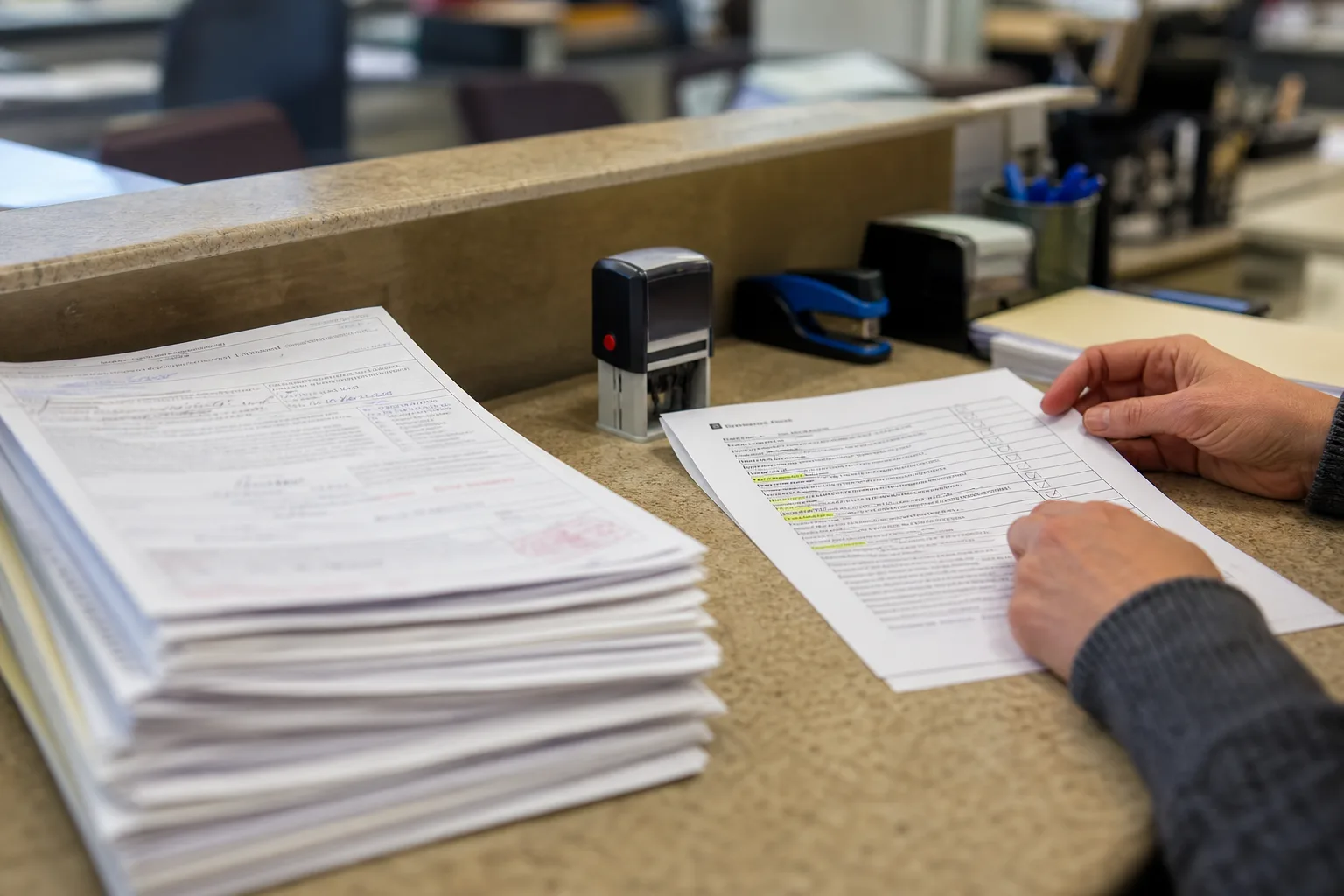
The usual way people decide whether to call an attorney is emotional arithmetic: how angry they are, how much money is at stake, whether the other side has hired one. That test misfires in both directions. It sends people to a lawyer over a two hundred dollar dispute with a neighbor that a letter and a phone call would settle, and it keeps them away from the deed, the beneficiary form, or the settlement release where a free template quietly fails eight years later. There is a better question, and it has nothing to do with the argument itself.
The test is not how serious it feels, it is who has to accept it later
Almost every legal document has an audience beyond the two people signing it. A deed has to satisfy a county recorder now and a title insurer at the next sale. A power of attorney has to satisfy a brokerage's custodian desk, which has never met you and answers to its own compliance rules. A separation agreement has to satisfy a mortgage servicer before it will take one name off a loan. That third party, absent from the room and unmentioned in the template, is the one whose standards actually govern. Write for the person in front of you and you may be writing for nobody.
This reframing does most of the work. If the only parties who will ever read the document are the two who signed it, and both of them intend to perform, a plain written agreement in your own words is often sufficient and sometimes better than a form, because you understand every line of it. If a stranger with a checklist has to accept the document before anything happens, the stranger's checklist is the specification. Attorneys, in practice, are hired far less often to argue than to produce paper that a fourth party will not bounce.
The consequences arrive years after the decision that caused them
The reason people rarely learn from this is that the failure is not adjacent to the mistake. A quitclaim deed filled out at a kitchen table to add an adult child to a house records cleanly, costs almost nothing, and looks like a small victory. The consequence surfaces at closing, six or nine years on, when the title company reads the chain, sees a transfer with no consideration recited, no release of a spousal interest, or a description copied from the tax bill rather than the prior deed, and declines to insure without a curative instrument. Now the fix costs real money, on a deadline, with a buyer waiting.
The same delay dresses up other failures. A handwritten beneficiary change is honored by nobody at the insurance carrier, which pays on the form it has on file, and the family discovers this in the worst week of the year. A homemade lien waiver signed to release a final payment turns out to waive the wrong scope, and the subcontractor's claim shows up against the property anyway. A settlement accepted directly from another driver's insurer resolves the property damage and, on a general release, closes the injury claim the reader did not know they still had. In each case the decision that mattered was made casually, months or years earlier, by someone who thought the problem was small.
The overlooked party is usually an institution with a rulebook
Once you start looking for the absent party, it turns up in most ordinary transactions. A landlord and tenant negotiating an early lease exit are also negotiating with a leasing company's collections vendor and, eventually, a credit reporting agency that will only ever see a balance and a status code. A couple dividing a retirement account is negotiating with a plan administrator that accepts a domestic relations order in one specific form and rejects everything else. A small employer writing a severance letter is drafting a document the state unemployment agency will interpret without asking what was meant. The Consumer Financial Protection Bureau oversees how mortgage servicers handle borrower requests, which is a useful reminder that servicers operate to written procedures rather than to the equities of your situation.
Institutions are not being obstructive. They are managing risk across millions of files, and their rules are the price of doing that at scale. What the trade knows, and does not often say out loud, is that a large share of legal work is translation: taking what two people agreed and rendering it in the dialect the gatekeeper accepts, in the sequence it accepts, with the recitals and signatures and notarizations it requires. That is unglamorous, it is priced accordingly when scoped narrowly, and it is where a few hundred dollars reliably prevents a five-figure problem.
Plenty of problems have no third party, and those you can handle
The inverse deserves equal weight, because the fear of legal trouble drives people to spend money on matters that will never leave their own hands. A dispute over a mis-delivered order, a billing error, a deposit a landlord is slow to return, a warranty a retailer is stalling on: these are two-party problems with a documented record, and the cheap tools work. A dated letter that states what happened, what you want, and by when. A complaint to the state consumer protection division or the licensing board that regulates the trade. Small claims court, which most states designed to be used without counsel and which imposes a modest filing fee.
The same is true of most agreements between people who genuinely want the arrangement to work and who will perform it themselves. A written understanding with a neighbor about a shared fence, a plain contract for a modest freelance engagement, a family loan with a repayment schedule: if performance depends only on the signers, clarity beats formality, and a document you wrote in your own sentences is easier to enforce in your own head. Escalate when something changes the audience: when the fence agreement needs to bind a future owner, when the freelance work involves someone else's confidential data, when the family loan needs the IRS to treat it as a loan rather than a gift.
Scope the hire around the gatekeeper, not around the fight
When the answer is yes, the useful instruction to an attorney is unusually specific: name the institution that has to accept the document, and ask for a version that will survive it. A title insurer, a specific plan administrator, a probate court clerk in a named county, a lender's assumption department. Attorneys who work in that area already know the local recording quirks and the forms particular custodians reject, and that knowledge is the thing you are buying, not the drafting. Framed this way, the engagement is bounded, the deliverable is a signature-ready instrument, and the fee is usually quotable in advance.
There is a green-sounding version of this that is worth naming plainly, because the label does a lot of work. Free online forms are marketed as the frugal, paperless, sensible choice, and for a simple bill of sale or a straightforward month-to-month lease they genuinely are. What the label conceals is that a document is only as good as the audience it was built for, and a national template is built for no jurisdiction in particular. The frugal choice on a deed, an order dividing a retirement account, or a release of any claim is the one that does not have to be redone under time pressure by someone billing hourly.
A practical habit follows. Before signing anything that transfers property, releases a claim, changes who receives money on a death, or ends a legal relationship, write down every party who will have to read that document in the next decade. If the list is just the two of you, proceed. If it includes a recorder, an insurer, an administrator, a servicer, or a court, spend the hour. The list takes two minutes to make, and it is a far more reliable signal than how the dispute feels on the day it starts.