10:32W35
Paying Someone to Clean for the First Time? Hourly, Flat Rate, and Who Holds the Money
How the same four hours get sold three different ways, and why the walkthrough before the final payment is the only quality control a first-time client actually has.
House & Home6 min
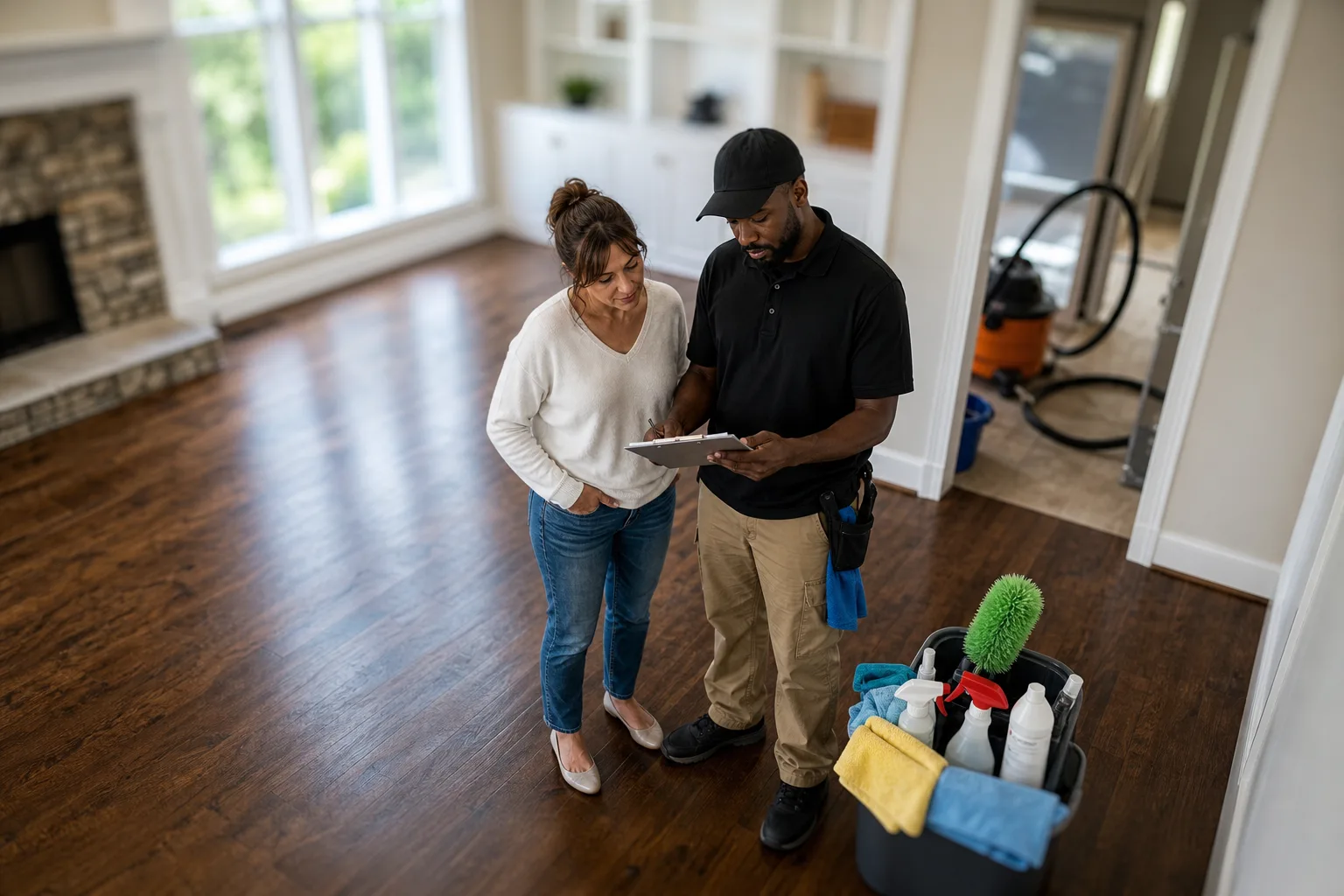
The first invoice for household work you used to do yourself is usually where you discover you bought something other than what you described. The house looks better than it did. Whether it looks as good as it should have, for the money, is a question you cannot answer without knowing what the trade thought it was selling. People who clean and maintain houses for a living carry a set of distinctions in their heads that almost never make it onto the estimate, and a first-time client, working from a phone call and a number, ends up agreeing to a scope nobody wrote down.
A deep clean, a maintenance clean and a move-out clean are three different products
Inside the trade these are separate jobs with separate hour counts, and the words are used precisely. A maintenance clean assumes somebody already did the hard reset: it is floors, surfaces, bathrooms, kitchen, trash, and it is priced on the assumption that nothing has been building up since spring. A deep clean is the reset itself, and it goes after the things that accumulate rather than the things that appear: baseboards, door tops, the range hood filter, shower door tracks, the inside of the microwave, window sills, light switch plates, the grout line where the tub meets the tile.
A move-out or post-renovation clean is different again, because it assumes the house is empty and that drywall dust has settled into every horizontal surface twice. The gap between a good job and a barely adequate one is almost entirely in that second category of work. A barely adequate crew cleans what a standing adult sees at eye level and leaves at the scheduled hour. A good crew works vertically, high to low, and treats the hour as the consequence of the scope rather than the boundary of it.
Which means your defense as a first-timer is not vigilance during the visit. It is a written scope before it. Ask for the task list the quote is built on, in writing, and read it for the items above and below eye level. If the list names baseboards, ceiling fan blades, the tops of door frames and the interior of appliances, you are buying a deep clean. If it names rooms and nothing else, you are buying floor space and a time slot, which may be all you want, but you should know that is the purchase.
Solo operator, small crew, national franchise
The same four hours are sold three ways, and the differences show up in the money long before they show up in the work. A solo operator is generally the lowest hourly figure and the highest consistency, because the person who quoted the job is the person doing it, and there is no substitution problem. The exposure is coverage: ask for a certificate of insurance naming general liability, and ask specifically whether it carries a bond, because a solo operator without either leaves you personally absorbing a broken heirloom or a scratched countertop.
A two- or three-person crew is the middle case, faster on a single visit, slightly more expensive per hour of labor delivered, and dependent on whether the owner works alongside the crew or dispatches it. Ask that question directly. A franchise or agency costs the most per hour and buys you the things that are boring until they matter: verified insurance, background checks, a supervisor, and a replacement when someone is out sick, which is the single most common reason a first-time client's schedule collapses in month three.
The payment terms track the model. Agencies typically want a card on file and bill on or before the day of service, which means the money leaves before the work is inspected. Solo operators and small crews are usually paid on completion, sometimes by check at the door, sometimes on a short invoice cycle. That ordering is worth noticing, because it decides who is holding the funds during the window when a problem is easiest to fix, and it is the reason a card-on-file arrangement should be paired with a written service guarantee and a stated re-clean window.
What each pricing model quietly rewards
Hourly pricing rewards thoroughness and caps nothing, which is why cautious clients dislike it and why it is nonetheless the right way to buy a first visit. Flat rate rewards speed, because every minute past the estimate comes out of the contractor's margin, and a flat rate set without a walkthrough is a flat rate that will be defended by leaving early. Per-room and per-square-foot pricing dominates carpet extraction, window washing and exterior soft washing, where the variable is measurable and the crew can quote it from the driveway.
The move experienced clients make is to buy the first job hourly with a not-to-exceed number written into the estimate, watch what the house actually takes, and then convert to a flat rate for recurring visits once both sides know the real hour count. That sequence protects the contractor from underquoting a house they have never seen, protects you from an open meter, and produces a recurring number that neither party resents. Contractors will generally agree to it, because the alternative is guessing, and guessing wrong on a recurring contract is expensive for them for a year.
Deposits, retention and the walkthrough that has to precede the final payment
For recurring housekeeping, a deposit is unusual and you should be mildly skeptical of one. For a one-time deep clean, a post-renovation cleanup or a large exterior job, a deposit in the range of a third to a half is ordinary and defensible, because the crew is blocking a full day, buying consumables and sometimes renting equipment. What matters is not whether a deposit exists but what it is documented against: a dated scope, a start date and a stated balance.
Hold something back. On any single job large enough to have a deposit, keep the last ten to fifteen percent until you have walked the house with the crew lead and a flashlight, at a normal pace, in daylight if possible. That walkthrough is the entire quality control mechanism available to a first-time client, and it works because it happens while the crew, the equipment and the unpaid balance are all still on site. Nothing you say two days later has that leverage, and good operators expect the walk and often propose it themselves.
Write the punch list down during the walk, hand a copy to the crew lead, and agree a date for the return visit. A contractor who fixes three items in twenty minutes while the van is still in the driveway has just cost you nothing and earned the recurring contract. One who wants the balance first and will schedule the corrections later is telling you how the next twelve months will go.
The upkeep jobs where paying out is clearly the better trade
Gutters, chimneys, second-story windows and roof-adjacent work are the clearest cases, and the reason is ladder height rather than skill. Fall protection in the workplace is regulated by the Occupational Safety and Health Administration, which is a reasonable signal about where the professional line sits, and a contractor working at that height carries insurance you do not. Carpet and upholstery extraction is the second clear case, because truck-mounted equipment removes water that a rental machine leaves behind, and post-renovation dust is the third, because it takes three passes and most homeowners stop after one.
Once you have paid for those and inspected them properly, the recurring interior work becomes a straightforward budget question rather than a leap. You will have a written scope, a known hour count, a crew whose walkthrough behavior you have already seen, and a payment rhythm you set rather than inherited.