16:54W29
New Phone in December, Tax Records in April. When to Actually Test a Restore
Household backup habits inherited their shape from tape rotation and then from file sync, and the season decides when the untested copy finally gets asked to prove itself.
Digital4 min
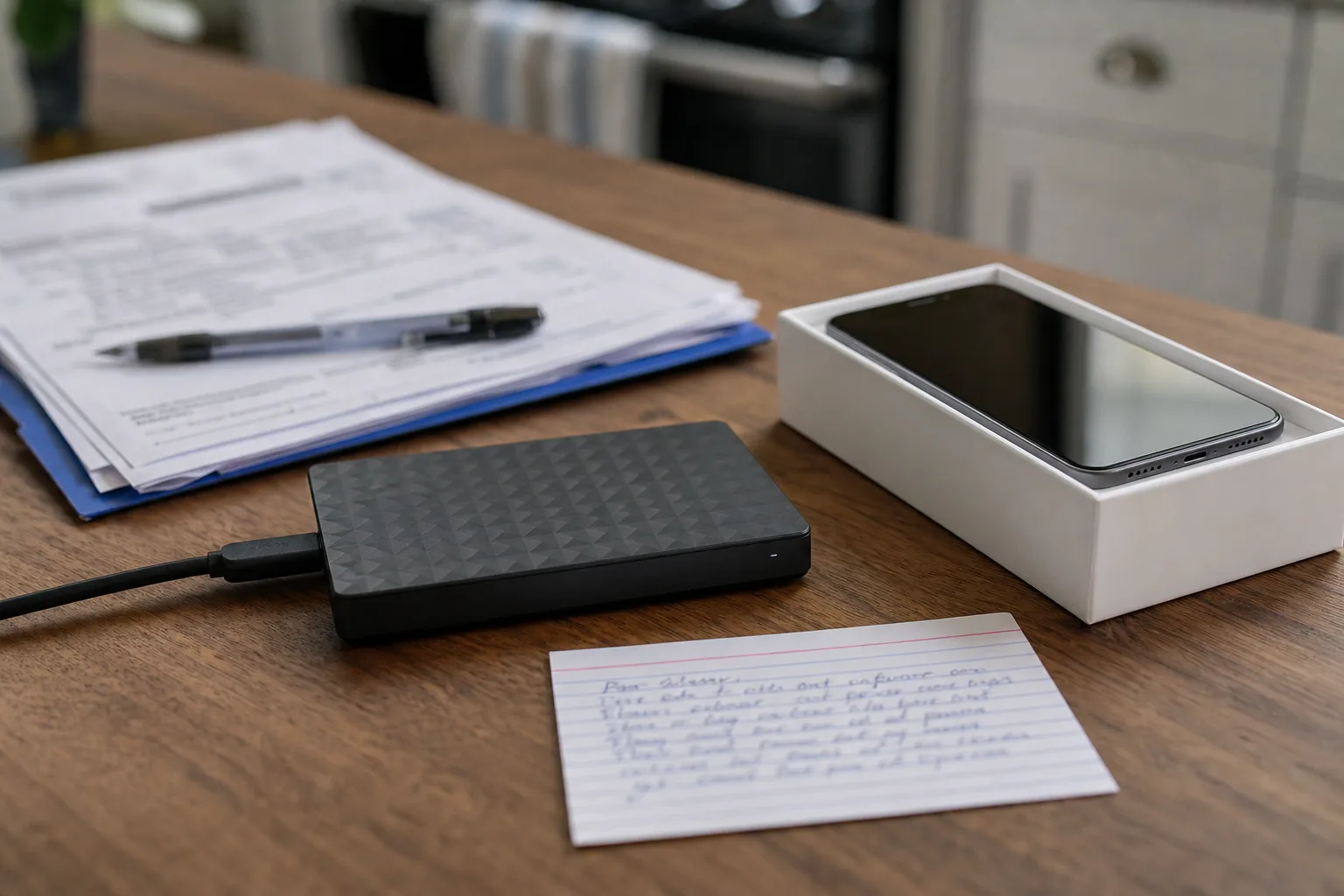
Most of what a household does with its files is a reversal plan, whether or not anyone calls it that. You keep a second copy of the photographs, the scans, the year's receipts, so that a bad morning can be undone rather than absorbed. That is the same instinct behind a cooling-off period or a refundable deposit: buy back the option to change the outcome. The difference is that a deposit is either refundable or it is not, and you can read the clause. A backup only reveals its terms at the moment you need it, which is the worst possible time to learn them.
The rotation habit was borrowed from tape, and it still shows
The shape of household backup practice was set decades ago in server rooms, by people managing magnetic tape that was expensive, slow, and finite. They built rotation schemes with family names, grandfather, father, son, so that a daily tape, a weekly tape, and a monthly tape each held a different depth of the past. The point was never redundancy alone. It was time travel: the ability to reach back past the day the corruption started, because damage is often noticed weeks after it happens. Consumer software inherited that logic without the vocabulary, which is why your machine keeps hourly, daily, and weekly versions and quietly discards the oldest.
The other inheritance is the rule most people can half recite: three copies, on two kinds of media, with one kept somewhere else. That phrasing came out of professional photography, from working photographers who were losing irreplaceable archives to single-drive failures and wanted a rule a person could hold in their head. It spread because it survived translation. A household with an external drive on the desk, a cloud account, and a second drive at a relative's house has satisfied it without owning a server or reading a manual, and the offsite copy is the one that answers fire, theft, and a burst pipe at once.
Then sync arrived and took the word backup with it
The consumer shift that changed everything was file sync, the folder that mirrors itself across a laptop, a phone, and a company's storage. It solved a real problem, and it made the second copy automatic for millions of people who would never have bought a drive. It also broke the old meaning of the word, because sync propagates rather than preserves. Delete a folder on a Tuesday and the deletion travels; encrypt a folder and the encryption travels; let a toddler rename things and the renaming travels. A mirror is not a memory. The providers know this, which is why nearly all of them added a version history and a deleted items window running thirty or sixty or ninety days.
That retention window is the clause worth reading, and it is the one most households have never looked at. It sets the outer limit of how far back a mistake can be reversed, and it is quietly different from one account tier to the next. Ransomware turned this from a technicality into the whole game. Once the common failure stopped being a dead drive and became a deliberate scrambling of everything reachable, the valuable copy became the one that the infected computer cannot write to: a drive that is unplugged between uses, or storage with versioning the attacker cannot silently overwrite. The National Institute of Standards and Technology is the federal body responsible for cybersecurity guidance of this kind, and its recovery material is written for organizations but reads perfectly well at kitchen-table scale.
The season supplies the test, if you let it
Households do not need a testing calendar invented for them, because the year already has two natural moments. The first is the device handover in late fall and December, when a new phone or laptop arrives and everything is supposed to move across. That transfer is a restore, performed under mild time pressure, with the old device usually still in the house. It is the cheapest test you will ever get, because the original is sitting right there as a fallback, and the failure modes surface immediately: the photos came over but the messages did not, the authenticator app did not migrate, the scanned documents live in an app that no longer exists.
The second moment is the run-up to tax filing, when a household reaches for records it has not touched since last spring. Bank statements, closing documents, receipts for a home office, the mileage log, the 1099s that arrived by email and were never filed anywhere. If those open cleanly from the backup rather than from the working machine, the archive is real. If they open only from the working machine, you have one copy and a comfortable feeling. Between the two dates sits storm season and the first hard freeze, when the physical risks to a house are highest and the offsite copy stops being theoretical.
What a real drill looks like at home
A test is not opening the backup app and seeing a green checkmark. It is choosing three or four files that would genuinely hurt to lose, deleting them from nowhere, and restoring them to a scratch folder on the desktop from the backup alone, with the working copy set aside and the internet off if the backup is local. Then open them. A photo library that restores as forty thousand loose files with camera serial numbers for names is technically recovered and practically useless, and you want to discover that on a quiet Sunday rather than after a theft.
Write down what you learned, in a plain text file kept with the drive: which account holds what, how long its deleted items window runs, where the recovery codes for the two-factor accounts live, and roughly how long the restore took. That last number is the one people underestimate. Then repeat the whole exercise when the next device arrives, because a restore that worked once on hardware you no longer own has not been tested since.
The thing that makes a backup worth its cost is the same thing that makes a refundable deposit worth its paperwork: someone checked the terms before the day they mattered. December and April both hand you the excuse.