21:42W28
Writing Your First Maintenance Schedule? Five Checks That Tell You Whether You'll Keep It
A first maintenance schedule usually fails for reasons you can see on paper before the first month is out. Five checks that catch them early.
House & Home6 min
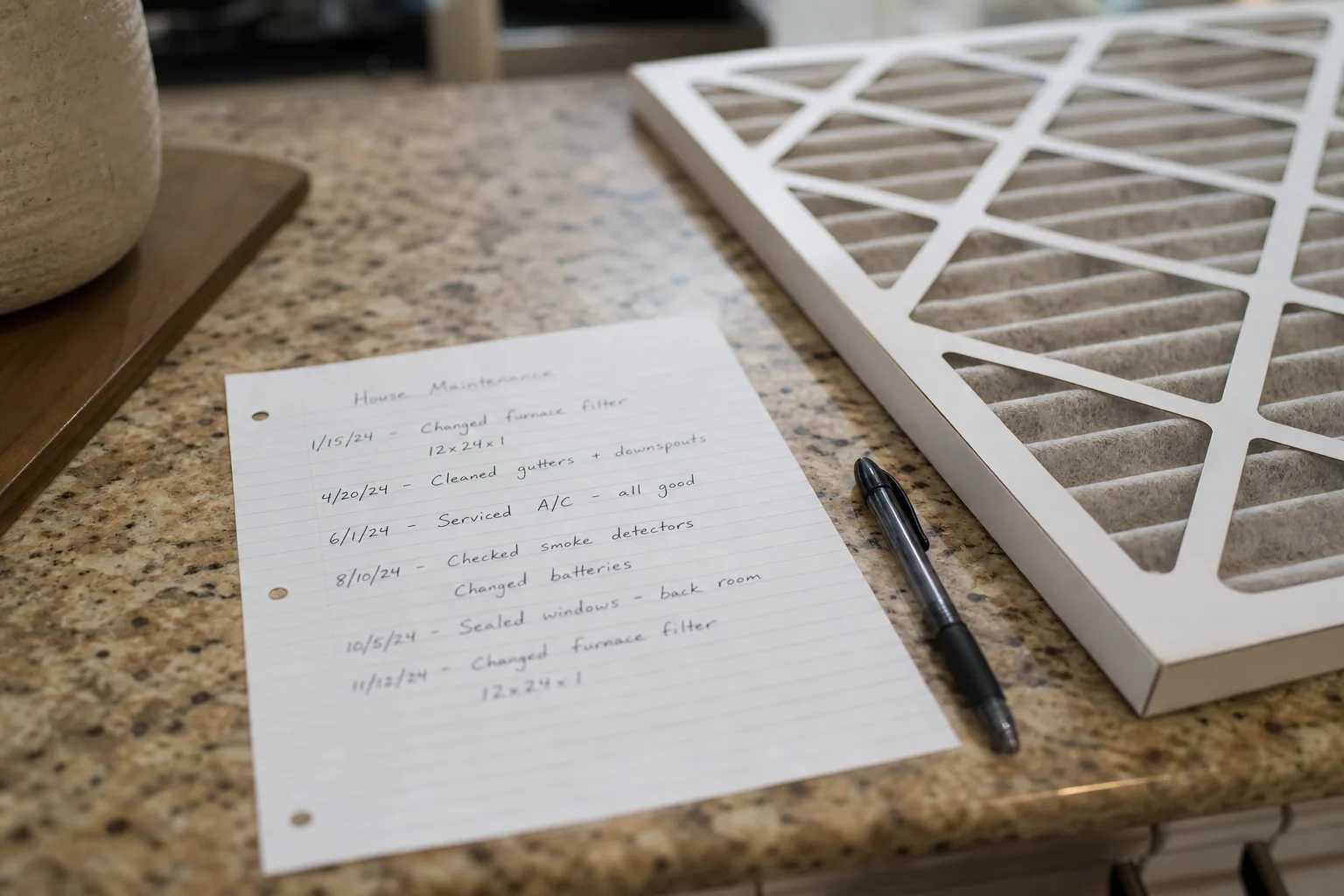
Most first maintenance schedules are written in a single sitting, usually after something went wrong, and they are abandoned somewhere around week nine. The failure is rarely laziness. It is almost always a design problem that was visible on the page from the beginning, and that the person writing it had no way to recognize because they had never watched a schedule die before. Property managers and facilities people learn this by attrition. They stop asking whether a plan is thorough and start asking whether it survives a bad month, a vacation, and a plumber who cancels twice.
1. Every task should hang off a trigger you would notice without the list
The weakest line in any first schedule reads something like "check attic every six months." Nothing in the world announces that six months have passed. The tasks people actually complete are pinned to events that arrive on their own: the first cold night, the last leaf off the maple, the week the clocks change, the day the property tax bill lands. A trade crew running preventive maintenance across a portfolio uses calendar dates because they have dispatch software and someone whose job is the calendar. You have neither. Write the trigger first and the task second, and cut anything you cannot attach to a real event.
This sounds like a scheduling trick and it is really a judgement tool. When you try to name the trigger for a task and cannot find one, you have usually discovered that the task does not belong in your schedule at all, or that it belongs to an annual visit from someone else. That is a useful outcome. A schedule of eleven triggered items beats a schedule of thirty dated ones every time, because the eleven get done and the thirty become a document you feel guilty about.
2. Add up the hours before you agree to any of it
Nobody writing a first schedule costs it in time, which is why the finished plan so often implies a second unpaid job. Go through line by line and put a number of minutes next to each occurrence, including the parts that are not the work itself: finding the ladder, buying the filter, waiting for the sediment to drain, putting everything back. Multiply by frequency and total the year. The figure that comes out is the real proposal you are making to yourself, and it is normally two or three times what you assumed while writing.
Seeing the annual number is what lets you make an honest trade rather than a hopeful one. Some tasks will justify their hours immediately, because the alternative is a failure that costs four figures. Others will not, and those are the ones to hand to a contractor, batch into a single day, or drop entirely with your eyes open. A schedule you have priced in hours is a schedule you can defend in March, which is exactly when first-timers quietly stop opening the file.
3. Separate the things that fail loudly from the things that fail silently
A dishwasher that stops draining tells you. A dryer vent packing with lint, a sump pump seizing between storms, a slow drip behind a wall, a water heater's anode rod dissolving to a wire: none of these announce anything until the announcement is expensive. This distinction is the single most useful sorting rule an amateur can borrow from the trade, because professionals build their whole preventive program around it. Loud failures can wait for the failure. Silent ones are the entire reason a schedule exists, and they deserve the good triggers, the reminders, and the hours you counted.
Run your draft through that filter and the shape usually changes. Cosmetic and convenience items, which is what first-timers overload the list with, move to a low-priority pile or off the page. Four or five silent-failure items move to the top with dates you will not miss. The plan gets shorter and considerably more valuable, and the reduction in items is what makes it survivable in a week when nothing else goes right.
4. Check whether the greener version of each task is actually the cheaper one
Maintenance is where environmental claims and household economics line up more often than they do almost anywhere else, but not universally, and a first schedule is where the difference gets set for years. Cleaning a condenser coil, sealing duct joints, flushing a water heater, and keeping refrigerator gaskets sealed all reduce energy draw and extend equipment life at once, which is why the Department of Energy treats equipment upkeep as part of its remit on residential energy use rather than as a separate housekeeping topic. Those tasks earn their place twice. Others earn it once, or not at all.
The counterexample worth understanding is the disposable filter. Changing a furnace filter on a fixed monthly schedule regardless of loading produces a stack of landfill pleats and a bill that buys nothing, while a filter left in past its useful life restricts airflow and makes the blower work harder. Neither habit is judgement; both are rules standing in for looking. Pull the filter, hold it to a light, and let what you see set the interval for your particular house, pets, and season. That single practice, applied across consumable items, is what separates a schedule that reduces waste from one that merely feels responsible.
5. Make the record of what you did, not just what you planned
The most common structural flaw in a first schedule is that it only points forward. There is a list of intentions and no history, which means that a year later you cannot tell whether the gutters were cleaned in October or skipped, whether the water heater has ever been flushed, or how long the last set of caulk actually lasted. Every trade that does this for money keeps service records, and not for tidiness. The record is where the interval comes from. Without it you are guessing at frequency forever and defaulting to whatever the manufacturer printed on the box.
Keep it crude. A date, the task, and one line on what you found is enough, written wherever you will actually write it. After two cycles the history starts telling you things nobody could have told you in advance: that this gutter run fills twice a year and that one never does, that the sediment in the water heater is negligible on your water, that the deck boards on the south side need attention at half the interval of the rest. That is the point at which you stop following a generic schedule and start owning a specific one. It also makes any eventual conversation with a contractor or an insurance adjuster shorter and more favorable, because you can produce dates.
What the second draft usually looks like
A schedule that has been through these five checks tends to come out about half the length of the first attempt, weighted toward silent failures, hung on seasonal triggers, and carrying a running log underneath. It will look thin next to the checklists circulating online, most of which were written to be comprehensive rather than to be followed. Thin is correct. The comparison that matters is not against an ideal plan but against what you would have done with no plan, and a short list that runs for five years beats a thorough one that runs for nine weeks by a margin that is not close.
Give the whole thing a review date roughly a year out, and treat that review as the real work. Items that were never once completed get deleted rather than renewed, intervals get adjusted to what your log shows, and anything that turned out to need a ladder you dislike gets handed to someone with better equipment. The schedule you keep is the one that has been edited by evidence, and the first year is when you collect it.