12:40W21
Your Appliances Got More Efficient and Less Forgiving. What Small Neglect Costs Now
Efficiency rules changed how much water and air your house moves, which quietly shortened the grace period on filters, gaskets, drains and vents.
House & Home4 min
A washer that smells faintly sour after a long weekend, a dishwasher leaving grit on the underside of bowls, a back bedroom that never quite warms up: these read as product complaints, and they get handled as product complaints, with a service call, a stronger detergent, or a space heater. Almost none of them start there. They start with a ten-minute job that was skipped for a season, in a house whose equipment has quietly become far less tolerant of that skip than the equipment it replaced. The tolerance changed. The habits mostly did not.
Less water, less air, and a shorter grace period
The machines in an average American house now do the same work with a fraction of the inputs they once used. Dishwashers run on a few gallons rather than many, front-loading washers tumble clothes through a shallow bath instead of filling a drum, furnaces extract enough heat from combustion gases to produce liquid condensate that has to drain somewhere, and building envelopes are sealed tightly enough that air leaves mostly where you tell it to. The Department of Energy is responsible for the appliance efficiency standards that drove much of this, and the savings are real. So is the consequence: every one of those changes removes surplus, and surplus is what used to absorb neglect.
Think of the old margins as slack in a rope. A dishwasher using twice the water flushed food debris past a filter nobody cleaned. A top loader diluted detergent residue and soil into so much water that biofilm never got a foothold. A leaky house exchanged its air several times an hour whether or not the bath fan worked. Furnaces that vented hot flue gas straight up a masonry chimney had no condensate line to plug. None of that slack survived, and the same weekly inattention that produced no visible result in 1996 now produces a smell, a film, or a fault code.
The laundry and kitchen symptoms nobody traces back
The most common one is the odor in a front-loading washer, and it is almost never the washer. Low-water washing leaves a thin film of detergent, fabric softener and body soil in the door gasket and the drain sump, and that film feeds an organism population that then transfers its smell onto clean towels. The fix is unglamorous and free: wipe the gasket fold dry, pull and rinse the drain filter behind the lower access panel every month or two, use the dose the machine asks for rather than the dose the cap suggests, and leave the door ajar. Households that do this rarely think about it. Households that do not end up buying odor removers, then a service visit, then sometimes a machine.
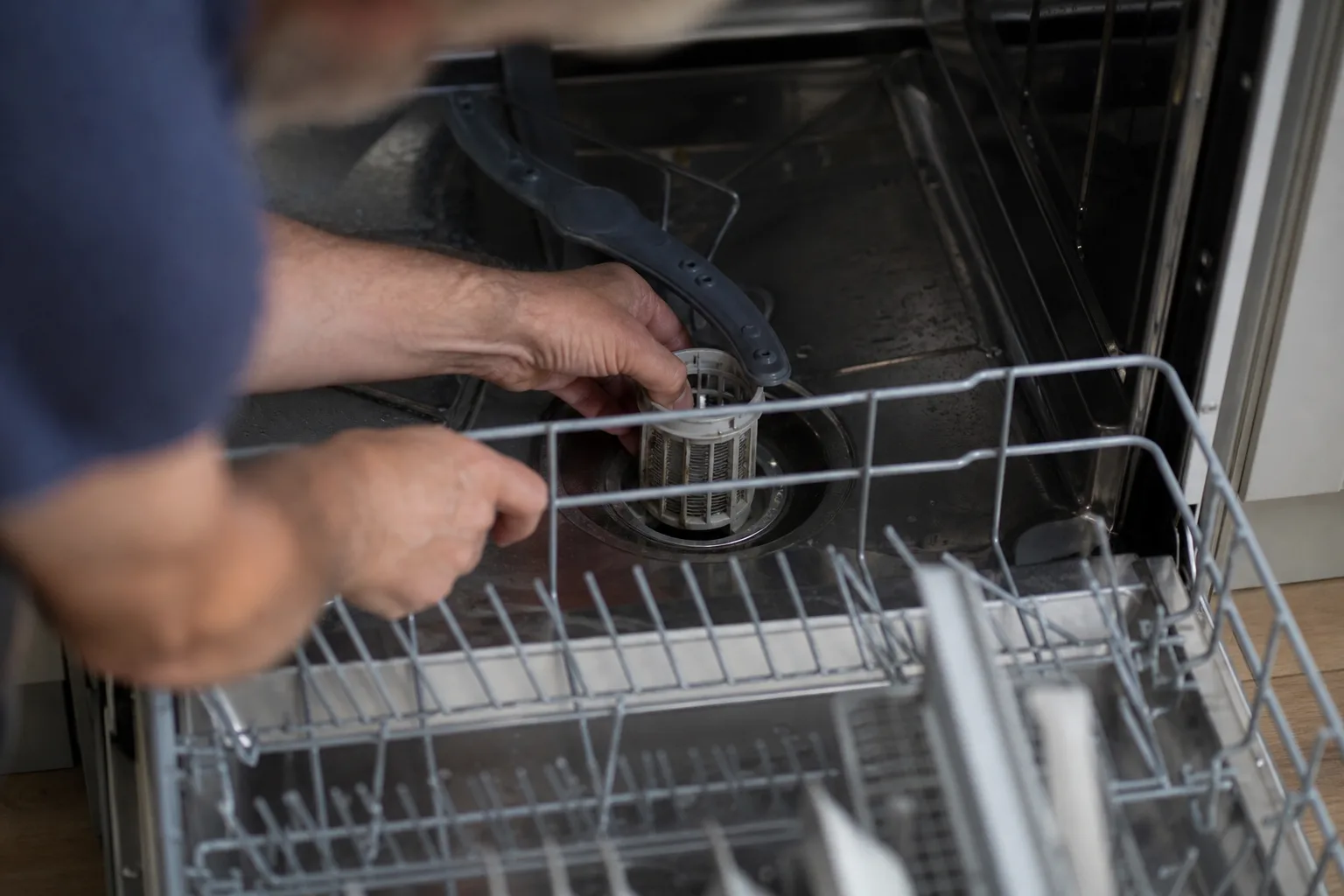
Dishwashers tell the same story through a different symptom. Modern units filter rather than grind, which is why they are quieter and use less water, and that filter is a cylinder in the floor of the tub that unscrews by hand. Left alone for a year it restricts flow, recirculates fine debris, and coats glassware in a haze that people blame on hard water and treat with a rinse aid that cannot reach the problem. Two minutes under a faucet resolves what a bottle of additive cannot, and it also removes the load from a pump that would otherwise be the expensive failure.
Air paths in a house that no longer breathes on its own
Tighter construction moved ventilation from something that happened by accident to something that happens on purpose, which makes every air path a maintenance item rather than a fixture. A bath fan clogged with lint no longer matters slightly; it matters entirely, because there is no longer a drafty window casing quietly doing the same job. A furnace filter left in past its date restricts a blower that is now often variable speed and pressure sensitive, so instead of simply moving less air the system runs longer, costs more, and eventually trips. The back bedroom that will not warm up is frequently the last symptom in that chain, not the first.
Two drains deserve a calendar entry of their own. High-efficiency furnaces and air conditioners both produce condensate, and both send it through a narrow plastic line that grows a slime layer over a season or two. When it blocks, the water backs into a pan, then into a ceiling, then into a claim, and the homeowner reports it as a roof leak in January because that is where the stain appeared. A cup of hot water and a wet vacuum at the outlet, twice a year, is the whole preventive program.
Where the compounding actually happens
The cost of small neglect compounds in three ways that rarely show up as a single bill. Energy first: a restricted filter, a lint-packed vent, or a scaled water heater makes equipment run longer for the same result, and that shows in twelve modest monthly increments rather than one alarming number. Component failure second: pumps, blower motors and heat exchangers fail early when they work against restriction, and a motor is a fraction of a machine's price until labor is added, at which point replacement starts to look rational. Damage third, and this is the one that changes a household's year, because water that escapes a blocked drain does not stay in the mechanical room.
There is a fourth cost that seldom gets counted, which is the shortened life of a good machine. Efficient appliances carry more embodied material and manufacturing energy than the simple ones they replaced, so the greener choice only stays green if it reaches its full service life. Cleaning a filter is not a virtue signal. It is the thing that lets the efficiency you already paid for keep arriving, year after year, without a second purchase.
Set the reminders by season rather than by memory, and put them where the equipment is: a note inside the laundry door, a date written on the filter frame in marker, a spring and fall pairing for the condensate lines. The list is short, the tools are a screwdriver and a rag, and the payoff is a house that keeps behaving the way it did the week everything was new.