14:50W20
Backing Up a Three-Person Bookkeeping Practice? What the Quote Covers and What the Restore Test Costs
A small accounting office is a useful test case for backup pricing: what the monthly line items actually buy, and what a real restore drill costs in hours and dollars.
Digital5 min
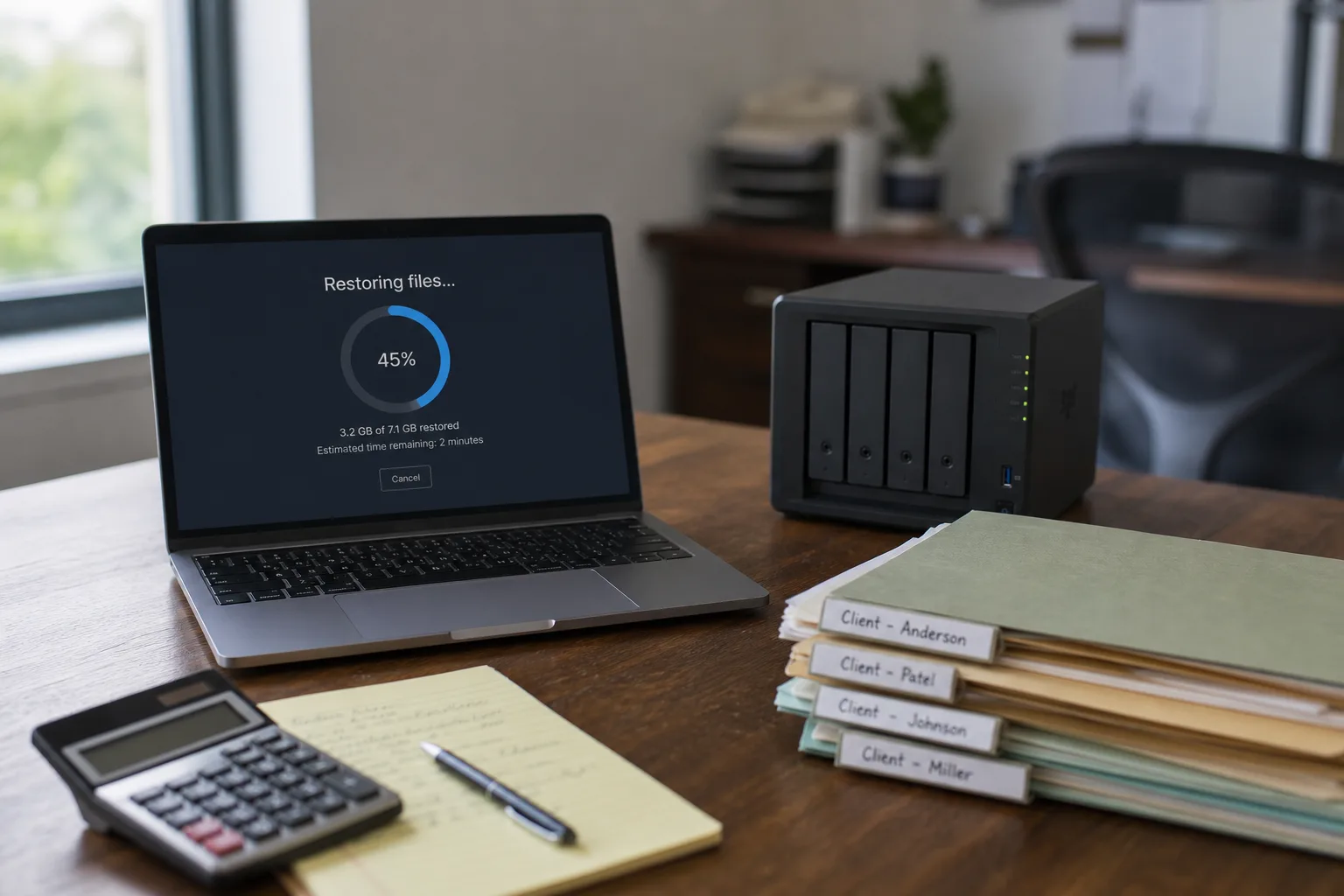
Take a narrow case and hold it still: a three-person bookkeeping practice in a leased suite, working on four laptops and one aging tower that runs the accounting software, holding client returns going back seven years, payroll files, scanned source documents, and a shared folder of engagement letters. Call it 1.4 terabytes, growing slowly, spiking every February. The owner has a backup arrangement she inherited from a prior IT contractor and has never once restored from. She is about to sign a new managed agreement with a monthly fee and a one-time onboarding charge. The interesting question is not whether backup is worth buying. It is what the number is made of.
What is actually being protected, and what it weighs
Before any quote makes sense, the data has to be sorted into categories that price differently. The seven years of finished returns are large, static, and almost never touched: cheap to store, tolerable to restore slowly. The current-year working files are small, change hourly, and are the ones whose loss ends a week. The accounting software's database on the tower is a third thing entirely, because restoring it means restoring a working machine, not a folder. Most quotes blur these together into a per-seat price and a storage allowance, which is convenient for the vendor and unhelpful for the buyer trying to understand what she is paying for.
Sort it yourself, in an afternoon, before the sales call. Write down how much data sits in each bucket, how often each changes, and how long the practice could function without it. The last figure is the one that drives cost more than volume does. A firm that can lose a day of work and survive buys a different product than one that cannot lose an hour during filing season, and the second product costs multiples of the first, not a small premium. Vendors will quote either one. They rarely ask which you need unless you raise it.
Reading the line items on a backup quote
The recurring fee usually resolves into four things wearing one label. There is raw storage, which is the cheapest component and the one everybody fixates on. There is retention, meaning how far back the versions go, which multiplies storage by a factor nobody prints on the front page. There is the software agent and its management, priced per device or per seat. And there is the recovery capability itself: whether the vendor will stand up a virtual copy of that tower for you while the real one is being replaced, which is the expensive part and the reason two quotes for the same terabyte count can differ by a wide margin.
Then there are the charges that only appear on a bad day. Egress or retrieval fees, common in the cheaper archival tiers, mean that pulling 1.4 terabytes back down costs real money at the exact moment you have no leverage. Some contracts cap the number of full recoveries per year. Some charge hourly for engineer time during a restore, at a rate well above the monthly fee. Ask for the disaster invoice, hypothetically, in writing: what does it cost to get everything back on a Tuesday in March. A vendor who answers that clearly is telling you something useful about the rest of the agreement.
The restore drill, and what an honest test costs
An untested backup is a receipt, not a safeguard. The practical test for this practice is not a checkbox in a dashboard saying the job completed. It is picking a specific client, a specific closed year, and a specific working file, and having someone restore all three to a machine that is not the one they came from, then opening them and confirming the accounting software reads the database without complaint. That is the whole test. It takes a competent technician somewhere between two hours and most of a day, depending on whether the software has to be reinstalled and licensed on the target machine first.
Price it as labor, because that is what it is. If the managed agreement includes an annual documented restore test, the cost is already inside the monthly fee, and you should ask to see the report from the last one the vendor ran for another client, redacted. If it does not include one, buy it separately at the hourly rate and schedule it for a slow month, not February. A firm this size can reasonably do a full drill once a year and a partial file-level spot check quarterly, which the office manager can run herself in twenty minutes once someone has shown her the sequence.
What the drill buys is not reassurance. It is a measured recovery time, written down, which turns a vague promise into a number you can plan around and, when the insurance renewal asks about business continuity, a number you can actually state. The National Institute of Standards and Technology is the federal body responsible for the standards and guidance that underpin how organizations approach contingency planning and recovery, and the shape of its advice has always been that a recovery capability you have not exercised is an assumption. Testing converts the assumption into a fact, and facts are what get budgeted.
What pushes the number up, and what quietly pulls it down
Four things drive cost up in a practice this size. Short recovery windows, because standby infrastructure has to exist and idle. Long retention, especially the multi-year versioned retention that a professional practice reasonably wants for client records. Immutability, meaning copies that cannot be altered or deleted for a fixed period even by an administrator with stolen credentials, which is the single most valuable feature added to small-business backup in the last decade and is worth paying for. And device count, since every laptop with local working files is another agent, another license, another thing to verify.
Pulling the number down is mostly a matter of not buying premium treatment for cold data. The seven years of finished returns belong in a cheap archival tier with slow retrieval, provided you have confirmed the retrieval fee and timing in advance. A local copy on a small network drive in the suite costs a modest one-time hardware outlay and cuts both restore time and cloud retrieval charges, and reusing the practice's outgoing tower as that target extends the working life of a machine that would otherwise be scrapped, which is a genuine saving in both directions rather than a label. Keep the local copy disconnected from routine network access so that ransomware cannot reach it, and treat it as the fast lane, not the only lane.
What to fix in writing before you sign
Get five things into the agreement. The recovery time objective in hours, not adjectives. The retention period per data class, stated separately for current files and archived returns. Whether an annual restore test is included and who writes the report. The full retrieval cost for the entire data set, including any per-gigabyte egress. And the exit terms: how you get your data out, in what format, at what cost, if you leave in eighteen months. That last one is where small practices get stuck, and it is cheap to settle at signature and expensive to settle later.
The practice in this example ended up paying slightly more per month than the cheapest bid and considerably less than the top one, because she bought fast recovery only for the tower and the current-year folder and let everything else sit cold. She knows, because she watched it happen, that a full restore takes an afternoon. That is the deliverable.