12:29W14
Shipping Fragile Goods for the First Time? What the Damage Claim Actually Covered
A first-season ceramics seller lost a run of parcels to breakage, and the claim file showed exactly where packing cost, carrier liability and contract terms decide who eats the loss.
Corporate5 min
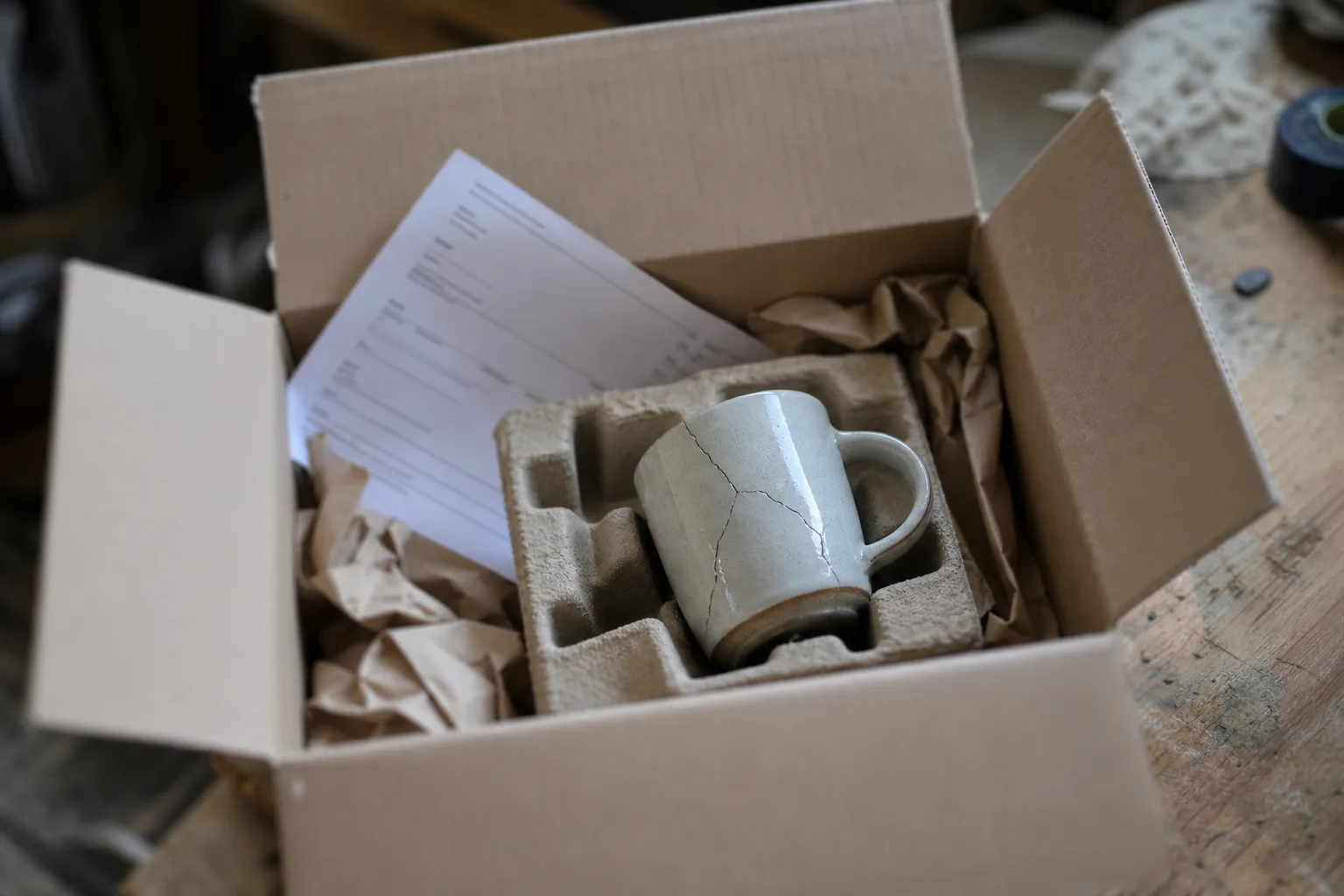
The case is a small ceramics studio moving from farmers markets to online orders, roughly six hundred units in its first quarter with a third-party fulfillment center, and a breakage rate that came in high enough to erase the margin on a good month. The founder had done what most first-time shippers do: bought boxes by the bundle in one size, filled the gaps with whatever the warehouse had on the shelf, and assumed the carrier's included coverage would handle anything that went wrong. Two of those three assumptions cost money. The third cost more, because it was about paperwork rather than padding.
What actually broke, and what the pattern said
Damaged parcels almost never fail randomly. In this case the returned units clustered in one pattern: mugs cracked at the handle, boxes with crush damage at a single corner, and consistent evidence that the product had been sitting against the wall of the carton rather than suspended inside it. That is a void fill problem and a box size problem, not a carrier problem, and the fulfillment center's own inbound photos showed it before anyone filed a claim. Parcels travel through automated sortation on belts and chutes, take corner impacts, and get stacked under heavier freight. The package is designed against those forces or it is not.
The single most useful thing the studio did was open every returned box before discarding it and photograph the interior. That produced a record of how the product sat when it failed, which is the evidence any carrier or insurer asks for and almost nobody has. It also settled an argument internally. The founder had assumed the warehouse crew was careless. The photos showed the crew packing exactly as instructed, into a carton with two inches of unsupported space on the long side, which no amount of care can fix.
What packing costs, per parcel, and what drives the number
Packing cost breaks into four buckets, and only one of them is the box. There is the carton itself, priced largely by wall construction and burst or edge crush rating, where a double wall runs meaningfully above a single wall of the same dimensions. There is void fill, priced by volume, so the same protection costs less when the box is smaller. There is labor, billed by the fulfillment center per unit or per minute, and a pack routine with six steps costs more every single time than one with three. Then there is dimensional weight, where an oversized box is charged as though it were heavy whether or not it is.
Those four move against each other in ways that surprise a first-time shipper. Upgrading to a heavier carton adds cents. Right-sizing the carton down one size took more cents back out of void fill and dimensional weight together than the upgrade cost, which is the usual result when someone measures instead of guessing. The comparison that matters is not box price against box price. It is total landed cost per delivered undamaged unit, and a replacement shipment carries the full production cost of the item, two legs of freight, the pack labor a second time, and a customer service exchange nobody billed for.
Once the studio ran that comparison, the case for a custom-fit insert stopped being an aesthetic argument and became arithmetic. Tooling for a molded pulp or die-cut corrugated insert has a real setup cost and a minimum order, which is why it looks expensive at four hundred units and cheap at four thousand. The break-even is calculable from the breakage rate, and it arrived faster than expected.
Who carries the loss, and where that is written down
Domestic parcel carriers include a modest default liability per package, typically a few hundred dollars of declared value, and additional declared value can be purchased in increments. That is not insurance in the ordinary sense, and the fine print in the carrier's terms is where first-time shippers get caught: coverage is commonly reduced or void where the carrier judges the packaging inadequate for the contents. Improper packing is one of the most frequently cited grounds for a denied parcel claim. The studio's first batch of claims was denied on exactly that basis, and the denial was, on the evidence, correct.
Two other documents decide the question before the carrier ever does. The first is the terms of sale on the studio's own website, which determined whether title and risk passed at the warehouse door or at the customer's doorstep. The second is the fulfillment agreement, which carried a liability cap and a claims window measured in days, not months. Reading both took an afternoon. Amending the website terms so that risk stayed with the studio until delivery was a deliberate choice, since customers will not accept a broken mug as their own problem, and pricing that risk in beat arguing about it later.
Where the greener option changed the number, and where the label did the work
Switching from expanded foam to molded pulp and paper void fill did three things at once here: it reduced material volume per parcel, it made the packaging curbside recyclable in most of the studio's delivery markets, and it protected better, because a fitted pulp insert restrains the product where loose fill only cushions it. That is the honest version. The dishonest version is the vendor claiming a mailer is sustainable because it contains some recycled content while being unrecyclable as a mixed material. The Federal Trade Commission is responsible for how environmental marketing claims are made to consumers, and its guidance on recyclability is the reference point when a supplier's deck gets enthusiastic.
The material choice that reduced damage was also the material choice that reduced waste, because every broken unit is a second box, a second truck movement and a discarded product. Right-sizing did the same work twice. The cases where green cost more were the ones where the packaging was doing nothing structural, and those were easy to identify once the breakage data existed.
For anyone about to sign a first fulfillment contract, the sequence is straightforward: measure the product, specify the pack in writing, test a shipment through the actual carrier network, then read the liability cap and the claims window before the deposit goes down. Damage stops being a mystery the moment somebody photographs the inside of the box.