13:33W14
Paying Monthly for Backups You Have Never Restored? The Test That Settles It
Backup practice was rebuilt around proving a restore rather than assuming one, and the custodian holding your only copy is the party most households never think about.
Digital5 min
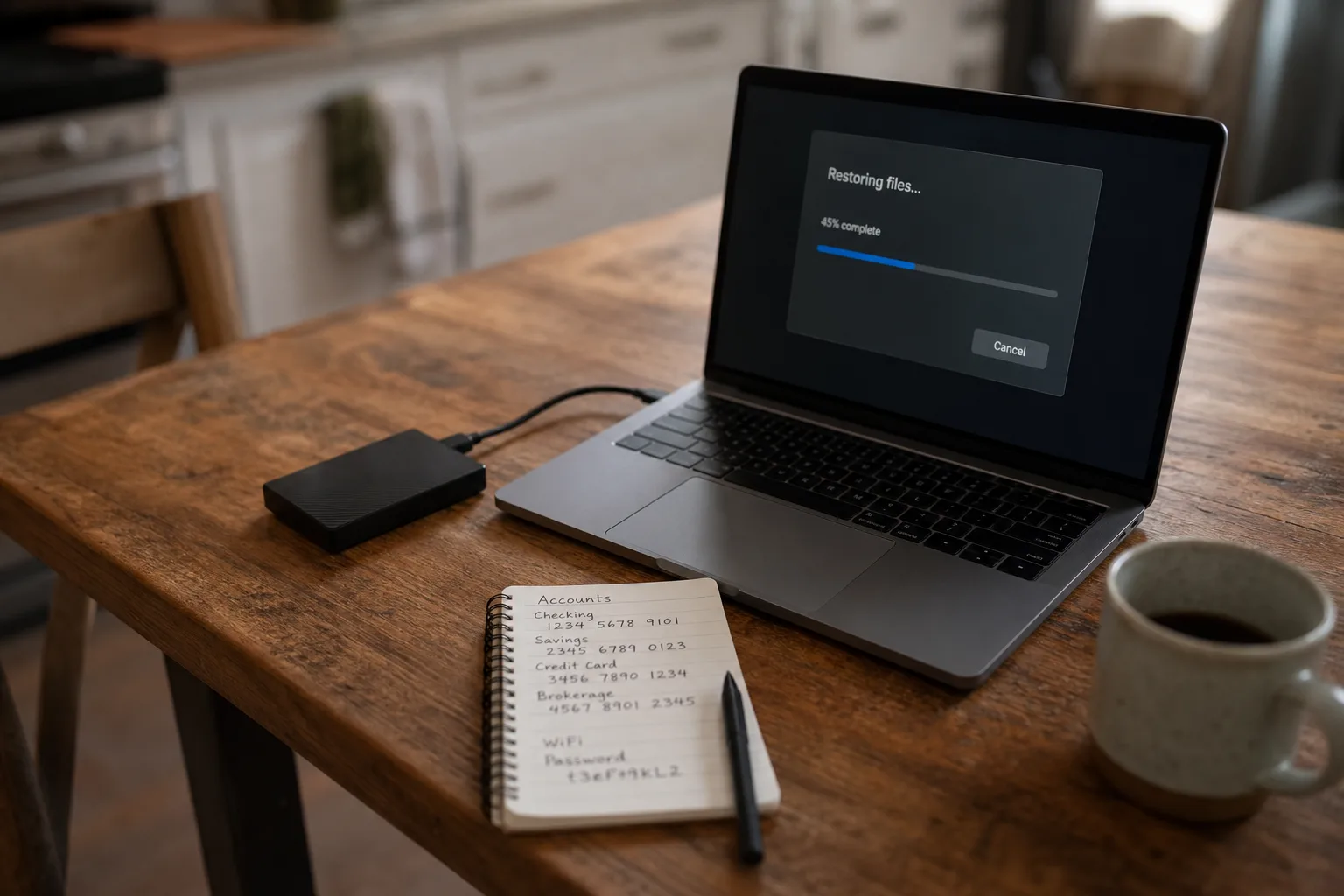
The invoice arrives every month and the service reports success every night, and between those two facts most households and small offices conclude that the matter is handled. It usually is not, or not in the way the payer imagines. A backup is a promise about a future event, and like any staged payment it is worth exactly what the final delivery turns out to be. Nobody discovers the gap on a quiet Tuesday. They discover it after a drive failure, a stolen laptop or a ransomware note, at the precise moment their leverage has evaporated.
How the practice moved from copying to proving
For a long stretch, backup meant tape and a rotation schedule, grandfather-father-son sets cycling through a safe and a courier, and the discipline lived in the log book rather than in the software. Restores were rare, slow and manual, so the people running them tested constantly, because a tape that had silently gone bad was a known failure mode rather than a surprise. Then came cheap disks, RAID arrays sold to small offices as protection, and a widespread misunderstanding that redundancy and backup were the same thing. Mirrored disks faithfully mirror a deletion. That lesson was learned expensively, in thousands of separate offices, one at a time.
Consumer sync services arrived next and made the confusion worse before they made it better, because a folder that appears on every device feels like insurance until an encryption event propagates to every device in under a minute. Versioning and retention windows were the industry's answer, and ransomware is what forced them from optional to standard. Immutable snapshots, copies that the account holder himself cannot delete during a fixed window, exist because attackers learned to hunt the backups first. The National Institute of Standards and Technology is responsible for the federal guidance on recovery practice, and the direction of that work has been consistent: a recovery capability is only real once someone has exercised it.
The party in the arrangement nobody names
Follow the money and a third party appears in a deal most people describe as two-sided. You pay a provider, the provider stores your data, and somewhere behind that provider sits the actual custodian: a datacenter operator, a storage subprocessor, sometimes a reseller whose name never appears on your card statement. That custodian holds the only complete copy of your working life while the job, meaning your continued operation, is still unfinished. In construction terms it is retention held by someone you never contracted with, and the release conditions are written in a document you clicked past.
Two questions settle most of it. First, what does a restore cost, in money and in time, as distinct from what storage costs. Some providers meter egress, some ship a physical drive for a fee, some throttle large recoveries in ways that turn a two-hour job into four days. Second, whose name is on the account, and what happens to the data if payment lapses for sixty days. Providers who answer both plainly in their published terms are telling you something useful about how they behave under pressure.
The restore drill, and what it actually has to prove
Testing a backup means retrieving something and confirming it opens, and the value of the test rises with how little you help it along. Start small: pick a document changed within the last week, restore it to a new location, and open it. That proves the pipeline runs. Then escalate to the test that matters, which is restoring an entire folder tree to a machine that was never the source, from a network you do not control, using only credentials you can reach without the failed device in your hand. Most failures surface right there, in the credentials.
Time the drill and write the number down, because recovery time is the figure that determines whether a plan is usable or merely technically correct. A restore that works but takes six days is a different product from one that takes four hours, and you are entitled to know which you purchased. Check the restored files rather than the file count: open a spreadsheet, play a video, confirm a database actually loads. Then repeat the drill on a schedule you will keep, twice a year for most people, quarterly for anyone running a business off the machine.
Retention, the word that means two things at once
In a construction contract, retention is money held back until the work has proven itself. In backup, retention is time, the window during which older versions remain recoverable, and the two ideas are closer than the shared word suggests. Both exist because the defect does not announce itself on completion day. Ransomware groups sit inside networks for weeks before triggering, quietly corrupting the copies made during the dwell period, which is why a thirty-day window that felt generous can turn out to hold thirty days of already-poisoned files. Longer windows and immutable snapshots are the fix, and they are now standard at modest cost.
Set the window against the thing you fear most. Household photo collections need long retention because deletions go unnoticed for months. Accounting data needs retention that survives at least a full filing cycle, since the IRS expects records to be produceable well after the return is filed, and a reconstructed year is a miserable substitute for the original files. Three copies, on two kinds of media, with one off site, remains the working shape. It survived tape, disk and cloud because it describes a structure rather than a product.
Who performs the restore when it is not you
The other overlooked party is a person: whoever will be asked to do this while you are in a hospital, on a plane, or dead. A backup keyed to one person's phone, one password manager and one memory is a single point of failure wearing a security costume. The fix is unglamorous and takes an hour. Write down the provider, the account email, where the recovery key lives, and the physical location of any local drive, then put that page somewhere a named second person can reach it, sealed if you prefer.
Tell that person what you expect of them, and if the stakes justify it, have them run the drill once themselves rather than reading about it. Bookkeepers, executors and business partners all end up in this role without warning. A successor who has already restored one folder knows the thing cannot be broken by trying, which is the belief that stops most people from checking in the first place.
The shift over three decades has been from copying, which anyone can do, toward proving, which almost nobody does until once. Run the drill once and the monthly charge stops being a subscription to hope and becomes a service you have inspected, on a schedule you set, before the day you need it.