18:31W13
Paying Per Visit for Upkeep? How the Payment Structure Decides What Gets Caught
Deferred maintenance is usually read as a discipline problem, but facilities departments treat it as a scheduling and payment problem, and homeowners can borrow the method.
House & Home6 min
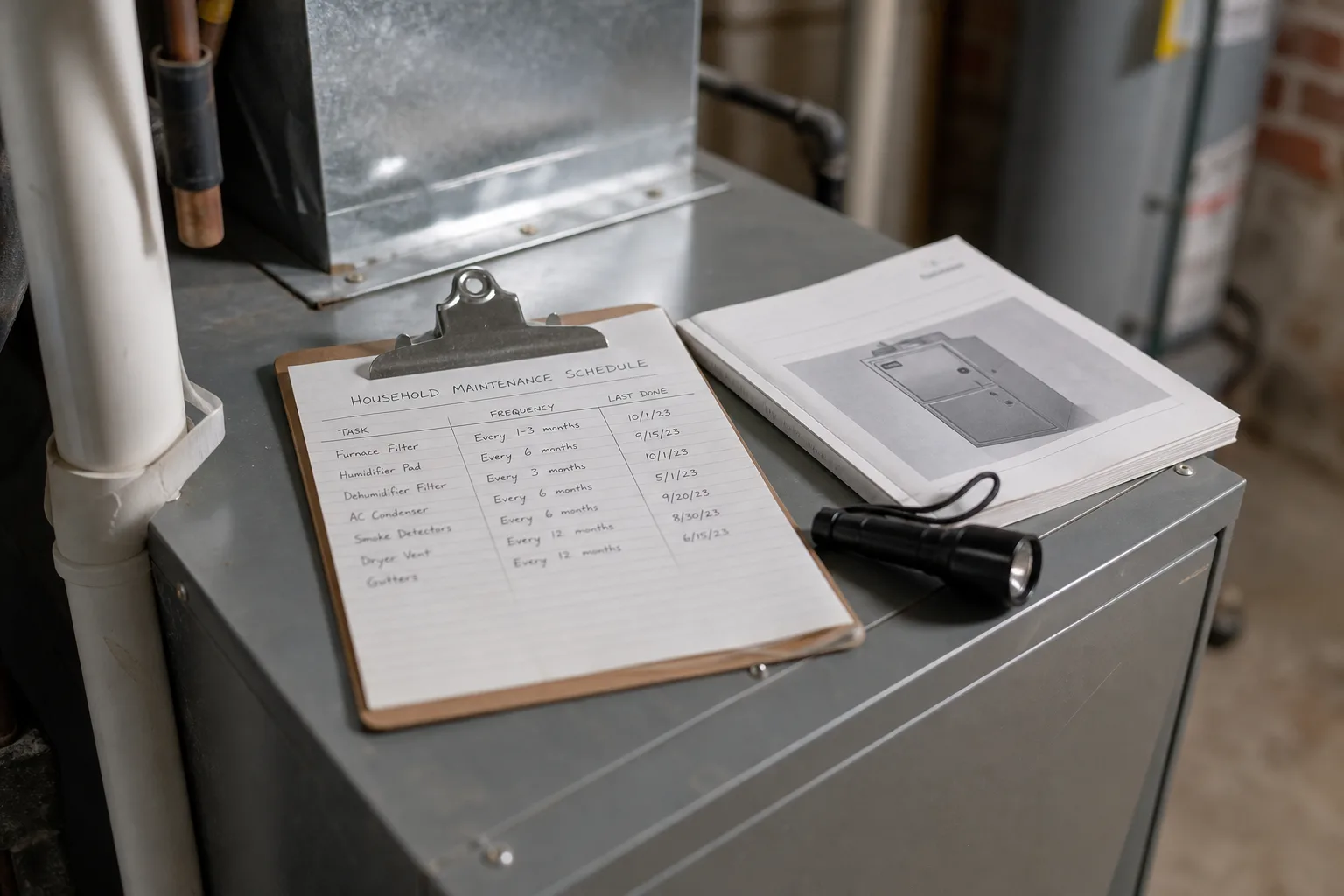
The usual explanation for deferred maintenance is character. Someone was busy, someone forgot, someone looked at the stained ceiling for two winters and decided it could wait one more. That story is comfortable because it puts the fault in a place you can promise to fix. It is also mostly wrong. Large organizations that own buildings employ people who are no more conscientious than the average homeowner, and yet their gutters get cleared, their filters get changed, and their small leaks get found while they are still small. The difference is not willpower. It is that somebody wrote the work down, attached a dollar figure to it, and decided in advance who would be holding the money when it came due.
The assumption is about discipline; the real variable is who scheduled the payment
Ask a facilities director at a school district or a hospital system how they keep small neglect from compounding and you will not hear anything about diligence. You will hear about a planned maintenance schedule, a per-asset budget line, and a vendor contract that pays out whether or not anything dramatic happens. The work gets done because the money was already committed, and money that has been committed tends to get spent on the thing it was committed to. Homeowners, by contrast, fund upkeep out of whatever is left, which means upkeep competes with everything else and loses.
That difference produces a second one, less obvious and more expensive. A household that pays per incident is buying diagnosis at emergency rates, from whoever answers the phone, on a day when refusing the quote is not realistic. An organization that pays on a schedule is buying diagnosis at scheduled rates, from someone who expects to return, before the failure has done its secondary damage. The compounding is not really in the physical decay, which is often slow. It is in the pricing of the eventual response, which is not.
So the practical question is not how to become the sort of person who remembers the crawlspace. It is how to move the crawlspace onto somebody's calendar, and how to structure the payment so that the person on that calendar earns money by finding things early rather than by being called out late.
Start with the list a building manager would write, not the list you feel guilty about
A facilities department begins with an asset register: every piece of equipment and building system, its age, its expected service interval, and its replacement cost. You can build the household version in an hour. Write down the furnace or heat pump, the water heater, the roof, the gutters and downspouts, the sump pump and any backup, the dryer vent, the washing machine supply lines, the water main shutoff, the exterior caulk and paint, the drainage grade at the foundation, the dishwasher and refrigerator supply lines, the chimney, and the attic ventilation. Beside each one, put the year it was installed if you know it and a guess if you do not.
Then split that register in two, because the split is what actually saves money. One column is work that requires no skill and only an interval: filters, vent lint, gutter debris, testing a sump pump, exercising the main shutoff so it does not seize. The other is work where you are paying for someone's eyes rather than their hands: a roof inspected from a ladder, a furnace with its combustion checked, a chimney scoped. The first column is a calendar problem. The second is a procurement problem, and it is where the payment structure starts to matter.
Equipment intervals are not folklore, either. The Department of Energy oversees efficiency standards for home heating, cooling, and water heating equipment, and manufacturers publish service intervals in the manuals that came with the units. Those documents are the closest thing a household has to the maintenance manual a building engineer works from, and they are usually available as free downloads by model number long after the paper copy has vanished.
Per visit, per year, or on retainer: what each arrangement actually buys
Pay per visit and you are buying labor for a defined task. That is fine for gutters and dryer vents, where the scope is obvious and the technician has no discretion worth worrying about. The weakness shows up on systems, because a per-visit contractor has no financial interest in the condition of anything he was not asked to look at, and no reason to tell you that the water heater's anode rod is finished when he came to bleed a radiator.
Annual agreements, the kind HVAC and plumbing companies sell as membership or maintenance plans, change that incentive in a useful direction and introduce a new risk in another. The useful direction: the provider has been paid to prevent a callout, so early findings help them. The risk is that you have prepaid a company that now holds your money and owes you future visits, which is exactly the position a homeowner should think about before the card is charged. Ask whether the fee is billed monthly or collected as a lump sum for the year, whether unused visits carry over, what happens to the balance if you sell the house, and whether the agreement converts to a discount on repairs rather than a refund if the company stops servicing your area. A monthly draft you can cancel is worth more than a modest discount for paying twelve months up front.
The larger organizations solve this with a service contract that specifies deliverables rather than visits: a written condition report per system per year, response times, and a scope of included consumables. You can ask for the same thing at household scale and many providers will supply it, because it is how their commercial division already works. A one-page report per visit, with photographs, is the single most valuable line you can add to a maintenance agreement. It converts a service call into a record, and a record is what makes the next contractor's estimate arguable.
Small jobs deserve small holdbacks and a written finish line
Retention is standard on commercial work: the owner keeps a percentage of the contract value, commonly a single-digit share, until the punch list is closed and the documentation is handed over. Nobody expects a homeowner to retain five percent of a gutter cleaning. But the underlying principle scales down cleanly, and it is worth applying to any upkeep job in the four-figure range. Do not pay the last portion until the work has been seen in the condition it was meant to fix. Gutters get paid after rain. Grading and downspout extensions get paid after rain. A repaired flashing detail gets paid after rain.
Deposits deserve the same scrutiny at small scale that they get at large. A deposit exists to cover materials the contractor must buy before starting, so a deposit on a labor-only visit has no justification, and a deposit approaching half the job value on a two-day repair is a financing arrangement rather than a materials advance. When materials genuinely are involved, ask for the supplier invoice or a materials list against the deposit figure. Providers who work on commercial accounts produce that paperwork without complaint, because their commercial clients require it.
Write the finish line down before the first dollar moves, in whatever form the provider will accept: an email confirming scope, the interval, the report, the consumables included, and the payment points. It does not need to look like a contract to function as one, and a short exchange of emails has settled more small disputes than any formal document.
What changes once the schedule holds
Households that make this shift usually report the same two things. The annual spend on upkeep goes up, visibly, because work that used to be invisible now has invoices. The spend on emergencies goes down further, and the emergencies that remain arrive as choices rather than ultimatums. That is the trade being made, and it is worth making deliberately rather than discovering it after a failure.
Put four dates in a calendar, pick one system to put under a written agreement this year, and hold back the final payment on the next job until you have seen it work.